Get Full Government Meeting Transcripts, Videos, & Alerts Forever!
Get email alerts on the Land Use topic
No spam. Unsubscribe anytime.
Rutherford County commissioners refer Plan Rutherford amendment back to planning commission after density debate
Summary
After hours of public comment and legal questions about whether adopting a comprehensive plan would carry the force of local law, Rutherford County commissioners voted 12–9 to send a proposed amendment raising the higher-end rural-living density (from up to 1 unit/acre to up to 2 units/acre) back to the planning commission for further consideration.
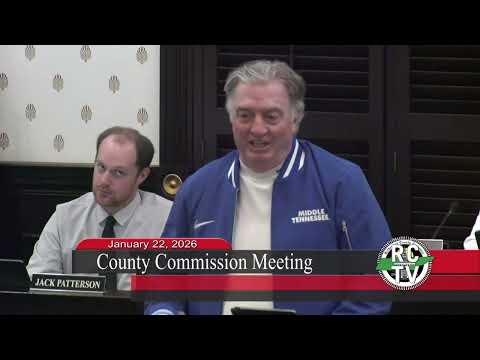
Rutherford County commissioners on Jan. 22 heard a two-hour presentation from Planning Director Doug DeMasi, took more than three hours of public comment, and then voted to refer a proposed amendment to Plan Rutherford back to the county planning commission.
DeMasi told the commission the update — the product of more than four years of public outreach — lays out a countywide vision and recommended character areas while leaving existing zoning unchanged. "If this plan is adopted tonight, the regulations that are currently in place do not change," DeMasi said, emphasizing that the plan is intended to guide later ordinance and map updates rather than automatically alter a property's zoning.
But legal and procedural questions dominated the afternoon. Commissioner John Dodd read a late-arriving letter from outside counsel asserting that formal adoption could "elevate the plan to the functional equivalent of a zoning ordinance." County Attorney Nick Christiansen told the commission that, under Tennessee Code Annotated, adoption gives the plan legal weight and subsequent land-use decisions must be consistent with it, while noting the plan includes language allowing case-by-case flexibility if infrastructure and site conditions justify it: "If this body adopts Plan Rutherford, it becomes local law," Christiansen said.
Much of the discussion centered on the plan's recommended density ranges for character areas. DeMasi summarized those ranges: rural preserve roughly one unit per five acres; county suburban 3–5 units per acre; and rural living with a lower end near one unit per five acres and a higher end up to one unit per acre. He added that the plan includes a caveat that the resulting densities "may be higher or lower depending on the unique circumstances of each parcel, including, but not limited to, the availability of infrastructure and the design characteristics of the proposed development."
Several commissioners and residents urged caution about adoption as written. Critics said the one-unit-per-acre upper end for the rural-living designation could reduce landowners' flexibility and raise housing costs; supporters said the plan protects rural character and directs growth to infrastructure-ready areas. Commissioners raised related concerns about schools, water supply, road capacity and outreach to affected neighborhoods.
After debate, Commissioner Dodd moved to propose an amendment that would change the rural-living "higher end" from up to one unit per acre to up to two units per acre and to refer that proposed change to the planning commission for reconsideration. The motion passed on the board vote, 12 yes to 9 no. Under state law the planning commission has approximately 61 days to take action; it may approve, reject or return the amendment without recommendation, and any revised proposal will come back to the county commission for final action.
What happened next: the commission did not adopt the plan as written that night; instead it referred the narrow density amendment for further public process and planning-commission deliberation. County Attorney Christiansen and Planning Director DeMasi told commissioners they expect additional public hearings and ordinance work before any zoning map or code changes would follow adoption. The planning director also noted that any subsequent rezoning or ordinance update would itself be a separate public and regulatory process.
Why it matters: The decision sends the plan back into the layered local review process rather than finalizing it and underscores a central tension the county faces — balancing pressure to preserve rural character with concerns about housing affordability and infrastructure funding. The referral preserves the planning commission's unanimous recommendation to the county while creating an explicit channel for commissioners who want a higher baseline density to press that change through the formal amendment process.
Next steps: The amendment will be considered by the Rutherford County Regional Planning Commission within the statutory review period and will return to the county commission for further public hearings and a final vote.