Get Full Government Meeting Transcripts, Videos, & Alerts Forever!
Get email alerts on the Parks Cip topic
No spam. Unsubscribe anytime.
Bonita Springs reviews parks CIP; FPL easement blocks permanent restrooms at Marnie Fields
Summary
At a Bonita Springs City workshop, Parks & Recreation Director Paul Perino updated council on baseball- and soccer-complex work, a proposed competition pool and park renovations; staff reported an FPL easement covering Marnie Fields that prevents permanent restrooms and described permit and cost hurdles.
Bonita Springs — At a city workshop, Parks & Recreation Director Paul Perino gave the City Council a project-by-project update on capital improvements across the park system and warned that a Florida Power & Light easement covering Marnie Fields prevents permanent structures there, complicating long-planned restroom and infrastructure work.
Perino told council members that the city had received written confirmation from FPL that "they do not permit any permanent structures in any part of their easement," including recently acquired property at Marnie Fields. That ruling, staff said, blocks the planned permanent restroom and leaves the city weighing interim trailer units, costly sewer hookups or asking FPL for a formal exception. Perino said the existing temporary trailer cost about $30,000 and that pump-outs drive operating costs; a permanent sewer and water hookup was estimated at roughly $250,000.
Why it matters: Marnie Fields serves youth sports and park users; without a permanent restroom, families and tournament organizers face logistical and accessibility challenges. Perino said staff would pursue formal outreach — including a drafted letter for the mayor’s signature and work through the city lobbyist — to seek a perimeter location or a written exception from FPL.
Perino also relayed a separate FPL estimate for undergrounding high-voltage transmission lines that cross the site: "It is $21,000,000 per line," he said, and noted five lines could total about $105,000,000 — a figure he characterized as prohibitive for the project.
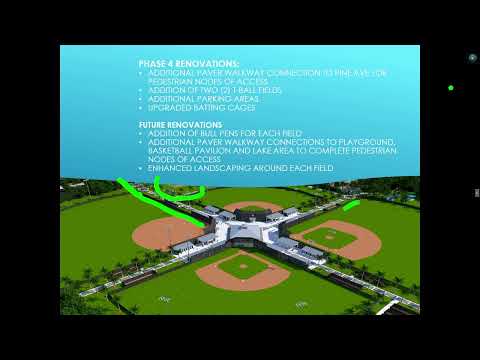
Beyond Marnie Fields, Perino walked council through multiple CIP projects. Work completed and underway at the baseball complex includes stormwater and ADA fixes, dugout and field renovations, upgraded concession and restroom facilities and LED field lighting; Perino said the Little League program serves more than 600 children. He added that phase 4 — planned tee‑ball fields and connector work to Pine Avenue drainage — triggers an Environmental Resource Permit (ERP) change and requires coordination with South Florida Water Management, extending the timeline.
On operating costs, staff told council the LED conversions are already cutting maintenance and energy expenses. For the baseball project Perino estimated combined maintenance and electric savings in the range of $44,000 to $50,000 a year.
Perino outlined a proposed new aquatic facility that would include a 0‑entry kiddie area, interactive features, a resort-style lazy river and a competition lap pool with starting blocks to allow the city and local high school to host meets. A public open-house workshop on that pool design is scheduled for Thursday, Jan. 15, 5–7 p.m. at the Venina Springs Recreation Center; Kimley-Horn holds the conceptual-design contract for the project and staff will gather public preferences on amenities and concessions strategies.
Several park upgrades were discussed in detail: the Leitner Creek Soccer Complex is at 100% design and awaiting permits from Community Development and South Florida Water Management; the original Bonita Soccer Complex will be asked at the council meeting that evening to replace metal-halide lights with LEDs to reduce glare and maintenance and to comply with the dark-skies ordinance. Community Park tennis courts were recently resurfaced and fitted with black vinyl fencing; staff said they cannot be double‑striped for pickleball because they serve as competition and practice courts for local schools.
Perino reported completion of Riverside Park phase 1 and said phase 2 — which includes interior infrastructure and artificial turf — will be more intensive and may shut portions of the park starting in early April and running through November, requiring relocation or cancellation of some events. Depot Park was described as a candidate for a larger "destination" playground and river-edge improvements, and staff said that public workshops may be scheduled for that project.
On memorial and civic improvements, Perino described design adjustments to the memorial walkway to preserve veterans’ bricks and said the city will absorb the cost of replacing existing bricks. He also presented options for the Lyles Hotel Plaza fountain — either refurbishing the pump mechanism or replacing the fountain — and said a decision would be part of the coming fiscal-year deliberations.
Perino closed by noting partnerships with Baron Collier and the Winter Gardens on separate park proposals and by asking council whether staff should draft formal outreach to FPL; council directed staff to draft a letter and pursue lobbyist outreach while continuing to evaluate interim restroom options and permit strategies. No formal motions or votes occurred during the workshop; no members of the public signed up to speak during the public‑comment period and the meeting adjourned.
Next steps: several items discussed — LED conversions, playground surfacing and other CIP awards — were on the council's upcoming agenda for formal approval; staff will return with permit updates, formal cost estimates and any written responses from FPL.