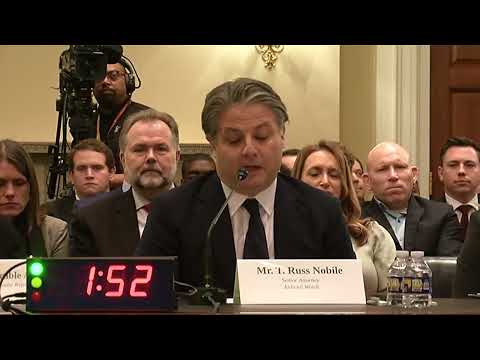
Judicial Watch lawyer tells House panel lax enforcement, not access, is eroding public confidence in elections
Loading...
Summary
Russell Nobill of Judicial Watch told the House Administration Committee that declining public confidence stems from lax enforcement of registration maintenance and expanded universal mail voting; he cited removal counts, state lawsuits and a recent Supreme Court decision allowing Judicial Watch to sue.
Russell Nobill, an election‑integrity lawyer with Judicial Watch, told the House Administration Committee that public confidence in U.S. elections is declining and that the problem stems from inadequate enforcement of basic safeguards rather than lack of ballot access. "Public confidence and integrity of elections is declining," Nobill said in his opening testimony.
Nobill framed his testimony around two linked themes:"clean registration lists" and limits on universal mail voting. He said turnout and registration have grown and that historical racial disparities motivating access expansion "have largely been eliminated," yet states are undermining integrity by failing to maintain accurate voter rolls and by expanding systems that, he argued, weaken chain-of-custody protections. "Universal mail voting is bad policy in any context," he said, adding it "increases the risk of coercion" and "risks third party interference and administrative error."
Nobill cited numerical evidence and litigation to support his argument. He said a Supreme Court finding showed "24,000,000 registrations, about 1 in 8 in The United States are invalid or inaccurate and 2,750,000 people were registered in multiple states." He also said Judicial Watch's enforcement work has resulted in "more than 5,000,000 ineligible registrations being removed nationwide." To illustrate what he called inadequate maintenance, he described an internal Judicial Watch analysis that found 21 counties with approximately 6,000,000 voters removed a combined 11 voters over two years for change of address.
Nobill pointed to the National Voter Registration Act (NVRA) as imposing modest list‑maintenance duties on states and said the NVRA guarantees access to records that Judicial Watch and others may use to verify compliance. He said many states "refuse, delay or claim the records do not exist," and that such refusals "defeat transparency" and prevent public oversight.
On litigation, Nobill said Judicial Watch has sued multiple states over practices that allow ballots to arrive days or weeks after Election Day. He said the Supreme Court recently ruled that Judicial Watch could sue in an Illinois case in which the organization represents a congressional client and that the court will hear a related matter on March 23. He also said Judicial Watch's client, the Libertarian Party in Mississippi, together with the Republican National Committee, successfully sued Mississippi in 2024 and that Judicial Watch filed a brief with the Supreme Court to defend that victory.
Nobill concluded by reiterating that election‑integrity safeguards have historical purpose and said he looked forward to the committee's questions.