Get Full Government Meeting Transcripts, Videos, & Alerts Forever!
Get email alerts on the Gifted Program topic
No spam. Unsubscribe anytime.
Wallingford‑Swarthmore outlines multiphase approach and RTI pilot to widen access to gifted services
Summary
District officials described a new multiphase referral model, continued use of balanced screeners (EMU) with one‑on‑one follow‑ups (KBIT), and an RTI pilot at MPE intended to speed access to enrichment and reduce equity gaps; board members pressed for data and resources.
Dr. Skoop, the district leader presenting the gifted program update, told the Educational Affairs Committee on Feb. 10 that Wallingford‑Swarthmore is shifting from a single‑test identification model to a multiphase system that combines universal screeners, curriculum‑based measures and targeted one‑on‑one assessments.
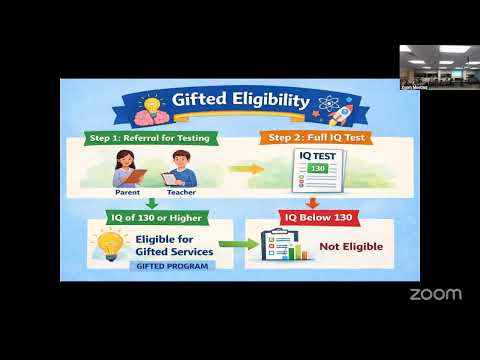
The change follows concerns about "upper underrepresentation of historically marginalized subgroups," Skoop said, and aims to reduce the district’s reliance on a single IQ cutoff. "Traditionally, to be eligible for gifted, you need a full scale IQ of 130 or higher," he said, adding that screeners "are predicting or hope to predict one thing, which is full scale IQ," and that the district needs other data points to make fair referrals.
Why it matters: district leaders said the multiphase model is meant to identify students who would benefit from enrichment but might be missed by group tests. Skoop said the district now uses a balanced group screener (EMU) as a floor, a one‑on‑one follow‑up (KBIT) for questionable cases, and composite rankings that weigh math and curriculum assessments to flag the top ~20% of students for referral to school psychologists for comprehensive evaluation.
David Mandel, elementary gifted department chair, described a pilot of a Response to Intervention (RTI) approach at MPE that provides tiered instructional supports earlier in the process. "By developing an RTI model ... we're using the data we have within the system and the indicators to start providing tiered levels of support," Mandel said. He and colleagues said the RTI work is intended to get supports "closer to the classroom" so teachers can address needs before or while formal identification is underway.
Board members asked about expansion, staffing and evidence. Skoop said scaling pilots depends on staffing and professional development: the district has instituted a year‑long professional development project to manualize referral procedures and reduce pressure on school psychologists. On preliminary equity outcomes, presenters said RTI and whole‑class enrichment have increased proportionality in who receives enrichment but cautioned that full evaluation data were not prepared for the meeting.
Cost and out‑of‑school programs: a public commenter asked whether recommended summer camps are subsidized. "There is no cost incurred by families" to be in the district’s gifted program during the school year, Skoop said, but presenters clarified that outside summer camps are not district‑funded and that the district does not typically provide scholarships for external programs.
Students with IEPs: presenters addressed 'twice‑exceptional' students (gifted plus disability) and said when gifted goals overlap with special‑education needs, the GIP (gifted individual plan) content is absorbed into the student’s IEP; any extended‑school‑year supports are governed by special‑education law.
What’s next: presenters said the district will continue the RTI pilot, expand professional development, refine composite scoring and follow up with more detailed equity and outcome data for the board.
The committee did not take formal votes on the presentation.