Butte‑Silver Bow committee pares presentation for council as Sabey data center details remain provisional
Loading...
Summary
An ad hoc Butte‑Silver Bow committee agreed to present a shortened slide deck and a technical addendum to the county council next Wednesday on the proposed Sabey colocation data center, while asking Sabey for clarifications on water discharge, cooling design and phased job estimates.
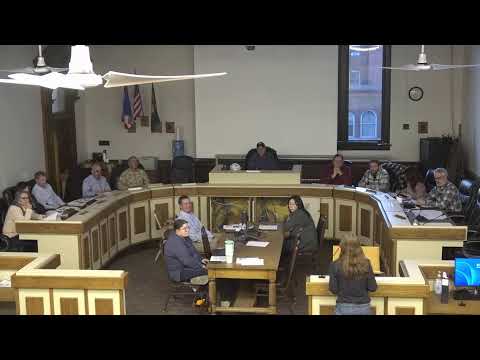
Chair Sullivan convened the Butte‑Silver Bow Ad Hoc Data Center Impact Committee on Feb. 11 to finalize slides and talking points for a county council presentation about a proposed Sabey colocation data center in the TED park.
The committee agreed to present a focused set of five primary slides covering water, power, jobs, taxes and environmental impacts and to publish a larger addendum with technical detail. "We want to hit the meat of the matter of those, the big 4," Chair Sullivan said during the meeting as members debated what to include in the pared‑down presentation.
Why it matters: the county council will see the committee's summary next Wednesday; the presentation is the committees principal vehicle for explaining the projects local impacts to elected officials and the public. Committee members stressed that the public should get readable topline figures while the appendices contain technical analyses.
On water, committee staff presented a full build‑out estimate of roughly 16,000,000 gallons per year for cooling water, noting that average daily use translates to about 40,000 gallons but that summer peak days (30–60 days per year) could reach on the order of 300,000 gallons per day. "What I did is I calculated the water used by the data center — the 16,000,000 gallons per year," said Bob Morris. Water‑system staff said the Silver Lake industrial system has pipe and diversion capacity that can be as large as 25,000,000 gallons per day at key intake points, but they cautioned that summer peaking and on‑site storage design will matter for operations and planning.
Committee members asked for comparisons to help lay audiences visualize the usage. "If you look at the average daily, it's about 45,000 gallons, which is a midsize hotel," Morris said, adding he would prepare a real‑world example for the slides. Members also noted that a Metro effluent reuse project scheduled to come online later this year could offset some irrigation demand and reduce net withdrawals from Silver Lake.
On power, the committee recommended a short slide noting total megawatts and the regulatory path: large electricity requests commonly proceed to the Montana Public Service Commission for a large‑load tariff or other review, with interveners such as environmental groups, consumer advocates, utilities and the developer participating. "There's a lot of rigor at the PSC," a committee member said, and staff agreed to add a slide summarizing the PSC docket process and likely interveners.
On jobs and taxes, members decided to present full build‑out estimates (the committee has cited roughly 200 long‑term jobs and up to 600 construction jobs over a multi‑phase, roughly 10‑year build schedule) while adding footnotes and phased breakdowns to make clear those numbers depend on tenants and phasing. "It's very dependent on the clients who are in the data center," a committee member said, noting that tenants drive staffing needs.
Environmental topics flagged for clarification included cooling blowdown/wastewater handling (no on‑site surface discharge has been proposed), generator testing and noise (monthly short tests were reported by the developer elsewhere), lighting design (committee requested downlighting), and hazardous/nonhazardous waste disposition. The committee asked Sabey to provide the developer's testing schedule and the detailed design for cooling and waste handling to include in the addendum.
Public commenters urged clearer explanations in the presentation. Jay Cornish asked the committee to quantify hazardous and solid waste handling; Cindy Perdue Nolan asked for an explanation of closed‑loop versus evaporative cooling; Evan Barrett urged the developer be asked to provide a sequential build plan rather than a single 10‑year job total.
Next steps: staff will consolidate edits, produce a pared‑down slide deck and a larger backup addendum, and circulate materials to commissioners by Friday; final printed handouts are to be ready Tuesday morning. The committee also moved to accept last week's minutes with a road clarification and set internal deadlines for final slide submissions.
The committee adjourned after public comment; the council presentation is scheduled for next Wednesday, when committee members plan to present the summary and be available for questions.