
Senate Education Committee advances a package of K–12 bills, including teacher-training, opt-out pay and benchmark reporting
Get AI-powered insights, summaries, and transcripts
Subscribe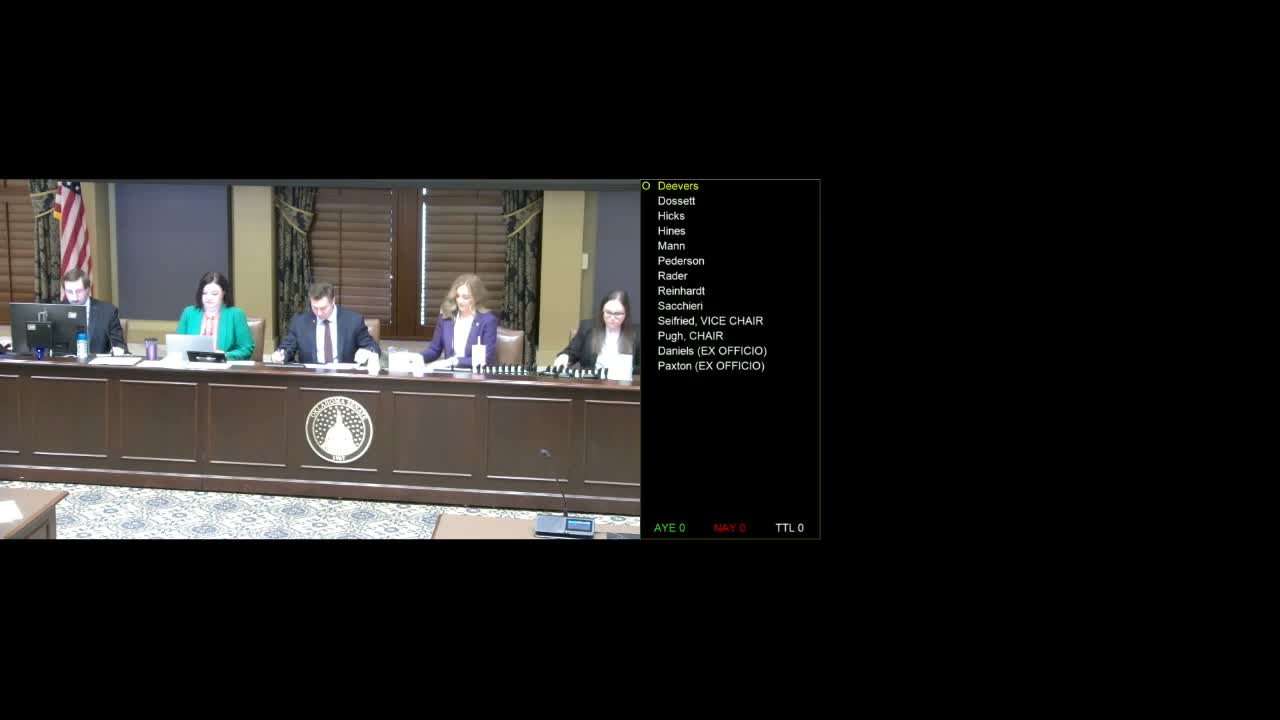
Summary
The Oklahoma Senate Education Committee on Feb. 11 passed a slate of bills affecting teacher training, adjunct limits, teacher benefits, literacy and math programs, and benchmark-data transparency. Several measures passed with strong bipartisan support; two bills were added to other business for later consideration.
The Oklahoma Senate Education Committee on Feb. 11 passed multiple education bills covering teacher training, reporting consolidation, adjunct-teacher limits, portability of career-teacher status, expanded math and literacy supports, and changes to employee benefit opt-outs, and it approved a transparency measure for K–8 benchmark assessments.
Floor Leader Daniels opened substantive action by sponsoring Senate Bill 17 26, which would require formal training for graduate teaching assistants, including instruction on students’ First Amendment rights, before they teach and evaluate courses. Daniels moved the bill “do pass”; with no committee questions or debate, the roll call recorded 9 ayes and 2 nays and the chair declared SB 17 26 passed.
In what became a recurring theme, Senator Bullard presented the Administrative Report Consolidation Act (Senate Bill 1236), proposing a consolidation board that would combine many statutory reporting requirements into 10 reports to reduce duplicative paperwork. Bullard told the committee that some administrators reported completing as many as 192 separate reports, arguing consolidation would allow administrators to spend more time with students. Chair and members pressed for assurances that any new board would produce implementable recommendations rather than add another layer of bureaucracy; the bill passed unanimously.
The committee addressed classroom staffing and qualifications. Senate Bill 14 13, sponsored by Senator Hicks, would require districts to notify parents when a classroom teacher holds an emergency certificate and impose a 270-per-semester limit on adjunct teaching assignments. Hicks and other members clarified that the “270” figure reflects a semester-length cap; the sponsor cited State Department of Education data listing about 2,664 emergency-certified individuals and roughly 2,400 adjunct instructors. Members expressed concern that a strict cap could constrain skilled adjunct teachers during shortages; the bill passed 6–3.
Lawmakers also moved reforms to teacher career mobility and workforce supports. Senator Dossett’s SB 13 17 would allow local school boards to vote to accept a teacher’s previously earned “career status” when she transfers districts so the status can be portable; the receiving district would not be required to accept it. The committee approved the bill, 9–0.
On instructional supports, Senator Seifried presented SB 13 60, a cleanup to the Oklahoma Math Achievement and Proficiency Act that restores instructional coaches and creates an in-house office of mathematics at the State Department of Education. Sponsors framed the bill as building on a prior three-year pilot for literacy coaches and as a step toward a longer-term numeracy strategy. Supporters argued that targeted coaching and sustained investment could address early numeracy gaps that affect later outcomes; the bill passed 9–0.
One of the more contested proposals was Senator Hamilton’s SB 13 42, which would raise the monthly health-plan opt-out payment for State Department of Education and school district employees to $500. Hamilton said the change is intended to increase employee choice and help with retention; he also cited an SDE fiscal-impact estimate of roughly $61 million if every eligible employee opted out, a figure he described as an upper-bound assumption. Committee members split on statewide funding versus local discretion; the committee approved the bill 7–3.
The committee passed several other items as well: SB 14 77 (adding a 21-year age limit to concurrent enrollment participation at the regents’ request), SB 11 89 (extending the School Security Revolving Fund pilot), SB 15 46 (expanding NextEd scholarships), SB 15 24 (requiring one-click access to school board contact information while protecting members’ private addresses), and SB 13 38 (making a literacy-instructional ‘HEROES’ team permanent and scalable). Sponsors described the literacy work as a train-the-trainer model that had reached dozens of schools during the pilot and which lawmakers said needs additional investment to scale. Several of these bills passed with bipartisan support.
In other business, Senator Reinhart introduced SB 18 12 to require public school districts that already administer K–8 benchmark or interim assessments to electronically report those results to the State Department of Education so parents can view benchmarks on the same platform used for statewide tests. Reinhart emphasized the bill does not mandate additional testing; its goal is to standardize reporting so parents and legislators can see early warning signs before problems appear on later state tests. Senators asked whether vendor dashboards’ parent‑engagement features would carry over to the state platform and raised concerns about the validity and reliability of screening tools being offered to districts; the sponsor said the bill intends to add benchmark results to SDE’s existing platform and that SDE should continue vetting assessment inputs. SB 18 12 passed.
Votes at a glance SB 17 26 — Training for graduate teaching assistants: Passed (9 ayes, 2 nays) SB 1236 — Administrative Report Consolidation Act: Passed (10 ayes, 0 nays) SB 16 33 — Codify higher-education residency practice: Passed (8 ayes, 2 nays) SB 14 13 — Parent notice for emergency-certified teachers; adjunct cap: Passed (6 ayes, 3 nays) SB 13 17 — Portable career teacher status: Passed (9 ayes, 0 nays) SB 13 60 — Math Achievement cleanup; instructional coaches: Passed (9 ayes, 0 nays) SB 13 42 — Raise SDE employee opt-out payment to $500: Passed (7 ayes, 3 nays) SB 14 77 — Concurrent enrollment age limit (21): Passed (10 ayes, 0 nays) SB 11 89 — School Security Revolving Fund extension: Passed (9 ayes, 1 nay) SB 15 46 — NextEd scholarship expansion: Passed (9 ayes, 1 nay) SB 15 24 — One-click school board contact info: Passed (9 ayes, 1 nay) SB 13 38 — Make HEROES literacy team permanent: Passed (10 ayes, 0 nays) SB 11 93 — Remove carryover cap: Passed (10 ayes, 0 nays) SB 18 12 — Benchmark reporting transparency: Passed (9 ayes, 0 nays) SB 16 17 — Added to other business and passed (9 ayes, 0 nays)
What’s next Many of the bills cleared the committee and will move toward appropriation or floor consideration as required. Sponsors asked colleagues to continue working on fiscal impacts and implementation details (for example, SDE’s fiscal impact for SB 13 42 and the scaling cost for literacy and numeracy coaching). The chair said the committee will reconvene next week and continue prioritizing bills signed and double-assigned for Appropriations review.
Reporting notes All quotations and attributions are taken directly from committee proceedings. The committee’s roll-call sequences and fiscal-impact numbers reported in committee were cited during the hearing; where a fiscal estimate was presented to the committee (for example, the SDE $61 million estimate for SB 13 42), it is described as the agency’s number as stated on the record.