
Lakewood staff propose broad Title 12/13/18 and Engineering Standards Manual updates; council flags downtown traffic fee and shoreline encroachment concerns
Get AI-powered insights, summaries, and transcripts
Subscribe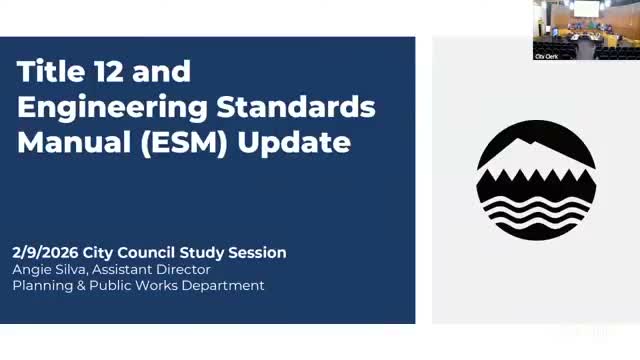
Summary
Staff presented draft updates to Lakewood Municipal Code Titles 12, 13 and 18 and the Engineering Standards Manual to align with state standards, clarify technical vs. policy language, and speed reviews. Council members applauded updates but raised concerns about relocating the downtown Traffic Management Fee into code without a fresh planned-action EIS and urged deeper review of street-end/shoreline encroachment language before adoption.
City planning and public works staff presented a package of proposed updates to Lakewood Municipal Code Titles 12 (Public Works), 13 (Public Utilities), 18 (zoning/procedures) and the Engineering Standards Manual (ESM) during the Feb. 9 study session.
Planning and Public Works Director Remack said the update is intended to improve consistency with federal, state and county standards, separate policy in Title 12 from technical design details in the ESM, and clarify procedures and technical authority. "This project initiated in early 2025...Tonight's study session is really focusing on the draft amendments, the Planning Commission's recommendations, but also next steps before this body," Remack said. He noted the Planning Commission recommended the draft by a 7-0 vote on Jan. 21.
Substantive changes include a three-tier drainage-review approach (simpler documentation for low-impact projects), relocation of certain sewer requirements to Title 13 with Pierce County code by reference, clarified rules for mandatory sewer connections and availability charges, and updated stormwater design references consistent with Ecology manuals. The ESM would provide unified technical standards for grading, access and permitting to reduce conflicts and speed reviews.
Council members asked detailed questions about implementation: requirements for redlined as-built drawings; the distinction between deviations (design substitutions that meet form-and-function) and variances (numerical exceptions); project phasing and cumulative additions under new stormwater manuals; and scope triggers for traffic studies and frontage improvements. Staff provided procedural clarifications and committed to follow up on specific redline language and examples.
Several council members raised policy concerns. Council member Branstetter asked about new standards for trash enclosures after staff described leak and illicit-discharge risks to stormwater and explained protections such as collection points and oil-water separators for new construction. Staff said retroactive enforcement is limited absent redevelopment, but annual stormwater inspections and education are conducted.
The downtown Traffic Management Fee (TMF) generated the most sustained debate. Staff said the TMF is tied to a planned-action EIS and SEPA mitigation and is not an impact fee; changing it substantially would require reopening the planned-action EIS. Several council members urged a separate study to assess whether the TMF is meeting goals (revenues and project delivery), and to consider alternatives such as impact fees or a trip-bank methodology. Staff recommended a future, separate review rather than addressing TMF mid-update.
Shoreline and street-end language also drew concern. Council member Talbot asked whether proposed edits reduce the city's enforcement authority over encroachments and street vacations; staff and the city attorney clarified that vacations are legislative council actions appealable to superior court and that additional local policy changes would require council direction.
Next steps: The council scheduled a public hearing for Feb. 17 and staff said the package could be continued for an additional study session if the council requests more detailed redline review, particularly on TMF and street-end/shoreline enforcement language.