Get Full Government Meeting Transcripts, Videos, & Alerts Forever!
Get email alerts on the K12 Budget topic
No spam. Unsubscribe anytime.
Franklin Public Schools proposes $81.2 million FY2027 budget to preserve level services; health‑insurance shift to town debated
Summary
District leaders presented an $81.2 million FY2027 operating request centered on maintaining current services amid rising health and special‑education costs; committee members pressed for details on health insurance, circuit‑breaker reimbursements, revolving‑fund reliance and staffing before a public hearing set for Feb. 10.
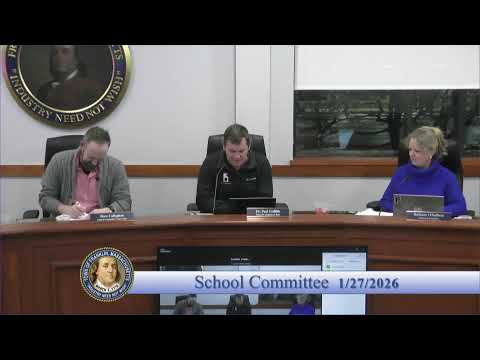
Franklin Public Schools leaders on Jan. 27 laid out a recommended FY2027 operating budget of $81,200,000 and urged the School Committee to approve a plan they said preserves current programs while absorbing rising fixed costs.
The spending request breaks into $72.3 million for operating costs excluding health insurance and an $8.8 million health‑insurance line, a 14% increase over FY2026. Presenters said the combined request equals a 3.6% increase over FY2026; excluding health insurance, the district is asking for a 2.5% operational increase.
“We built a budget that protects core programs and balances rising fixed costs,” the lead presenter said, emphasizing a 0‑based budgeting process that examines every line item. The presentation credited last year’s reorganization with approximately $3.1–$3.2 million in recurring cost avoidances that helped stabilize the request.
Why it matters: Franklin educates about 4,327 students but spends below the state average on a per‑pupil basis, presenters said. At the same time, special‑education tuition and related services continue to rise faster than state aid. District staff told the committee they expect circuit‑breaker reimbursements (a state program that pays 75% above a statutory threshold) to cover only part of those outlays and warned the gap between special‑education costs and reimbursements is widening.
Key budget drivers and proposals
- Salaries account for the largest share (roughly two‑thirds) of the operating request; presenters said 1% of the budget equals about $885,000. - Special‑education tuition and related services were cited as a major pressure; presenters said the district currently sends about 77 students out of district and that changes in caseload or tuition rates can produce substantial year‑to‑year swings. - Health insurance is a significant budget pressure. Administrators told the committee they are in talks to move the school health‑insurance accounting into the town’s centralized benefits line (department 910) to improve forecasting and eliminate duplicate accounting; the change would not alter employee coverage or collective‑bargaining agreements.
Committee reaction and next steps
Committee members asked detailed questions about the required local contribution, the consequences if the municipality fails to meet net school spending, how the district calculates savings from consolidation, staffing and vacancy counts, and which revenue lines are one‑time. Presenters repeatedly emphasized limited local control over some drivers (state‑set tuition increases, health‑insurance premiums and state aid formulas) and said the administration will provide a full budget book on Friday, Feb. 6.
Public process: The committee set a public hearing for Feb. 10 to review the budget line‑by‑line. The administration said the budget book will be posted in advance and that committee members and residents will have an opportunity to comment before a scheduled committee vote on Feb. 20 and subsequent town finance and council reviews in April–May.
Quotes from the meeting
- “We’ve generated approximately $3,200,000 in avoided costs that would recur annually through the reorganization,” a presenter said while describing savings from school consolidation. - On circuit‑breaker reimbursements: “We are getting $4,700,000 in reimbursement but our costs are expecting to go up to $9,700,000,” a finance presenter said, illustrating the growing gap between special‑education costs and state reimbursement.
What’s next
Administrators will publish the FY2027 budget book by Feb. 6, the committee will hold a public hearing on Feb. 10, and the committee will consider a vote on the recommended budget on Feb. 20. Separately, the committee will consider at a special online meeting whether to formally move the school health‑insurance accounting into the town health‑benefits line; the administration said it will circulate a memorandum of agreement and legal review before that vote.
Reporting note: Quotes and figures in this article are drawn directly from the School Committee’s Jan. 27 presentation and the public Q&A the same night. The committee’s public hearing on Feb. 10 will be the next formal opportunity for residents to question line items and projections.