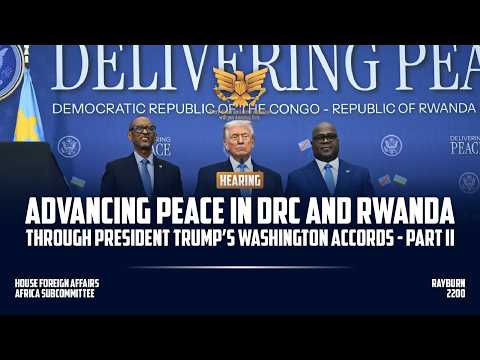
House Foreign Affairs hearing presses enforcement of Washington Accords and tougher rules on cobalt supply chains
Loading...
Summary
Lawmakers and outside experts told a House Foreign Affairs subcommittee that the Washington Accords need stronger enforcement, including sanctions and traceability requirements, and pressed for legislation to block minerals tied to child labor from U.S. markets.
Chairman Smith told a House Committee on Foreign Affairs hearing that the United States must ensure full implementation of the Washington Accords between the Democratic Republic of Congo and Rwanda and warned that ‘‘the peace has its enemies’’ after a recent attack that he said threatened the accords' progress.
Experts at the panel framed the accords as a rare diplomatic opening but said success depends on enforcement. Ethan Tan, a policy analyst at the America First Policy Institute, described early implementation steps — regular bilateral meetings, African Union oversight teams and a regional economic integration framework — as necessary to protect U.S. interests and stabilize supply chains for critical minerals. Tan said the accords reduce risks to U.S. access to strategic minerals but cautioned that implementation remains fragile.
Chairman Smith and other members discussed pending legislation aimed at curbing imports of minerals refined with forced or child labor. Smith identified H.R.2310, the Cobalt Supply Chain Act, and said the bill would create a rebuttable presumption that cobalt refined in certain jurisdictions is inadmissible to U.S. markets. ‘‘If the cobalt stays in your Congo or processed by a nearby friendly country … we will have achieved much,’’ Smith said.
Ambassador Tony Hall, a long‑time humanitarian advocate, tied humanitarian harms directly to mineral supply chains. ‘‘They are powered by cobalt and lithium and blood,’’ Hall said, urging enforceable transparency requirements, penalties for corporations that traffic in tainted minerals and consumer education modeled on campaigns that reduced blood‑diamond sales.
Members and witnesses discussed targeted financial measures against entities tied to the Rwandan state and military interests as one enforcement option. Ethan Tan recommended sanctions against holding companies associated with the Rwandan government and urged coordinated multilateral pressure to compel withdrawal of forces aligned with M23.
The hearing underscored competing priorities lawmakers said must be reconciled: attracting responsible investment while preventing human rights abuses and diverting revenue to local communities rather than foreign or corrupt actors. Christian Gerard Nima, a nonresident scholar at the Carnegie Endowment for International Peace, argued the accords should be anchored to broader governance reforms in the DRC to prevent instability from recurring.
Chairman Smith said the subcommittee will pursue additional hearings and legislative efforts to strengthen traceability and enforcement. No formal legislative action was taken at the hearing; lawmakers said they expect further oversight and possible sanctions if parties fail to comply with the accords' terms.