IonQ and UNM urge New Mexico to act quickly to anchor quantum industry with state partnerships
Loading...
Summary
Executives from IonQ and University of New Mexico officials told the Senate Finance Committee New Mexico has existing lab and university assets and offered coinvestment, cluster siting on state land, and a navigation team to speed permits and retain graduates. They cited multibillion-dollar global opportunity estimates, existing federal and state awards, and urged urgent action to secure anchor tenants and workforce pipelines.
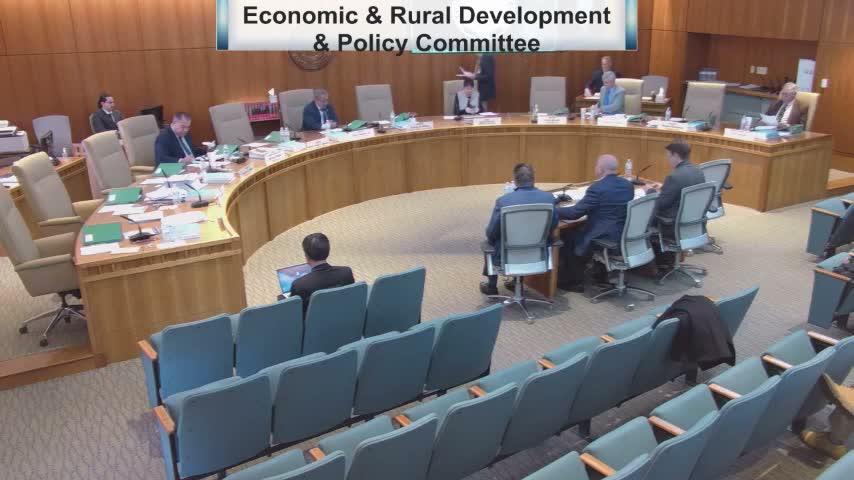
Albuquerque — Executives from IonQ and research leaders from the University of New Mexico told the Senate Finance Committee that New Mexico is well positioned to capture a large share of the nascent quantum computing industry — but only if the state moves quickly to create coordinated incentives, land and permitting certainty, and workforce pathways.
Philip Farah, vice president of strategic partnerships and sales for IonQ, said quantum is “transitioning from a lab concept to commercial reality,” and cited McKinsey estimates that the technology could add “$1 to $2 trillion” annually to global GDP by 2035. He said data from the industry projects a future workforce of 840,000 jobs, with roughly 250,000 created by 2035, and warned that early adopters will capture the bulk of economic value.
Farah described IonQ as a horizontally and vertically integrated company that combines computing, sensing and networking and offered the company as a potential "anchor tenant" for New Mexico if the state provides a workable package. "We are prepared to co-invest and engage in a recoverable matching approach," he told the committee, adding that IonQ has spent about $4,000,000,000 acquiring companies in recent years and can provide an exit path for successful local startups.
David Hanson, associate vice president for research at the University of New Mexico, presented a statewide ecosystem plan and pointed to current public and federal investments that he said show momentum. Hanson said the state and its partners won a combined state and federal EDA Tech Hub award of about $127,000,000, that the New Mexico Economic Development Department provided $25,000,000 to launch the Roadrunner Quantum Lab, and that DARPA has committed to at least $60,000,000 in matched funding for the Quantum Frontier Project.
Hanson outlined four priorities to "win": a sustained center that coordinates activity, a sustained workforce, a cost‑effective ecosystem for industry, and a stronger entrepreneurship pipeline. He said UNM and partner institutions are building training programs, including cohorts at Central New Mexico Community College, and that many of the initial hires are technician and applied skills roles rather than Ph.D. positions.
Committee members asked presenters how the state should organize and what incentives or supports would be required. Senator Padilla pressed on who should own coordination; Farah said successful strategies typically combine an economic development office seat at the table, university leadership and private‑sector consortiums. Hanson said QNMI (Quantum New Mexico Institute) and related university structures can provide convening and implementation capacity.
Several senators and a private investor urged more concrete state commitments: identifying parcels of state land for clustered campuses, dedicating agency staff to a single point of contact or a "concierge" team to speed permitting, and offering financial tools beyond traditional tax credits (for example, recoverable tax refunds and coinvestment mechanisms) to support companies that are capital‑heavy before revenue accrues.
On security and environmental concerns, Farah said the timeline for quantum’s cryptographic risk has accelerated and recommended simultaneous investment in quantum‑secure networking, which he described as complementary and already deployed in other parts of the world. He also said IonQ machines consume little power — "less than my two air conditioners at home" — and that emissions are tied to electricity generation rather than the devices themselves.
Presenters did not request or record a formal committee vote during the hearing. Several lawmakers linked the briefing to pending legislation (SB177 and SB36) and to the DARPA partnership as the likely mechanisms to structure incentives and governance. Lawmakers asked staff to produce plans and suggested assigning account managers to guide companies through environmental, state lands and other permit workflows.
What happens next: committee members said they will continue to refine legislative language and consider proposals to set aside land, dedicate staffing for rapid permitting and expand the state’s incentive stack to attract anchor tenants and manufacturing operations. No formal action or votes were taken at the conclusion of the briefing.