Committee recommends expansion of presumptive cancer coverage for firefighters
Loading...
Summary
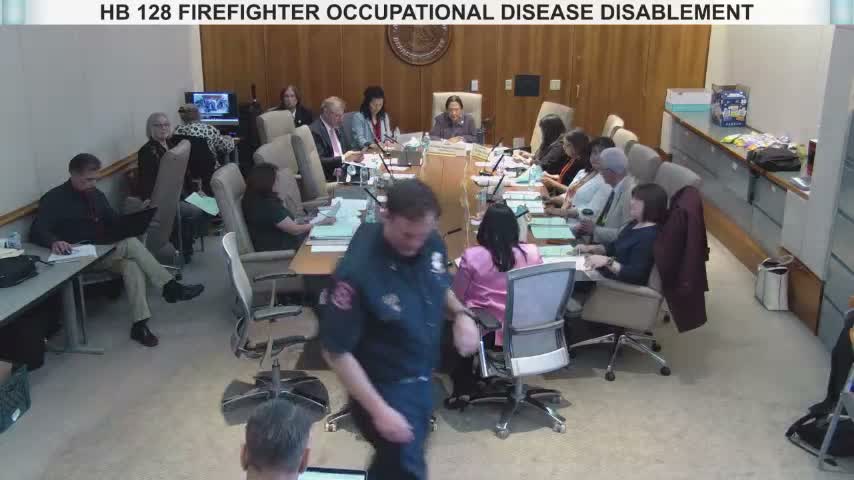
House Bill 128, which would add cancer types and set a five-year employment baseline for presumptive workers'comp coverage for firefighters, received strong testimony from medical experts, union leaders and affected firefighters and was given a committee 'do pass' recommendation. Witnesses cited modern research and federal action in support.
A sponsor presented House Bill 128 to update New Mexico's Occupational Disease Disablement Act so firefighters with specified cancers would receive presumptive coverage for workers' compensation. The presenter said the update aligns state timelines and covered conditions with recent federal action and modern research.
Dr. Dan Wu, a physician, epidemiologist and former firefighter, told the committee that occupational cancer in firefighters has reached epidemic proportions and cited the International Agency for Research on Cancer's review classifying firefighting exposures as carcinogenic. "The science is settled," Dr. Wu said during testimony, arguing that expanding presumptive coverage would let firefighters focus on treatment rather than proving causation.
Firefighter organizations and labor groups, including Miguel Tippman of the New Mexico Professional Firefighters, urged the Legislature to shift the burden of proof away from sick workers. "Put the burden of proof on the, not on the employee to fight for his or her rights when they're fighting for this cancer," Tippman told the committee. Several firefighters and paramedics gave personal testimony about cancer diagnoses and described how presumptive coverage would help families avoid financial hardship during treatment.
Witnesses discussed specific bill features: the measure sets a baseline employment period of five years (a number sponsors said mirrors federal compromise timelines), adds several cancers to the covered list and eliminates prior age cutoffs for some female-specific cancers. Committee members pressed witnesses on the reasoning for the five-year baseline and whether new research justified adding cancers that earlier statutes had excluded; witnesses replied that female-specific conditions are better supported by recent data and that the five-year baseline is a pragmatic, federally informed compromise.
Dr. Wu also cited economic context, referencing NIOSH data suggesting that paying out fatal versus nonfatal cancer cases has very large per-case costs, and argued that earlier identification and presumptive coverage can reduce long-term costs to payers and communities. Representative Anaya moved a 'do pass' recommendation and Representative Hall seconded; the committee recorded the recommendation and adjourned.