
District finance update: governor’s January proposal shrinks COLA outlook, staff flags one-time grants
Get AI-powered insights, summaries, and transcripts
Subscribe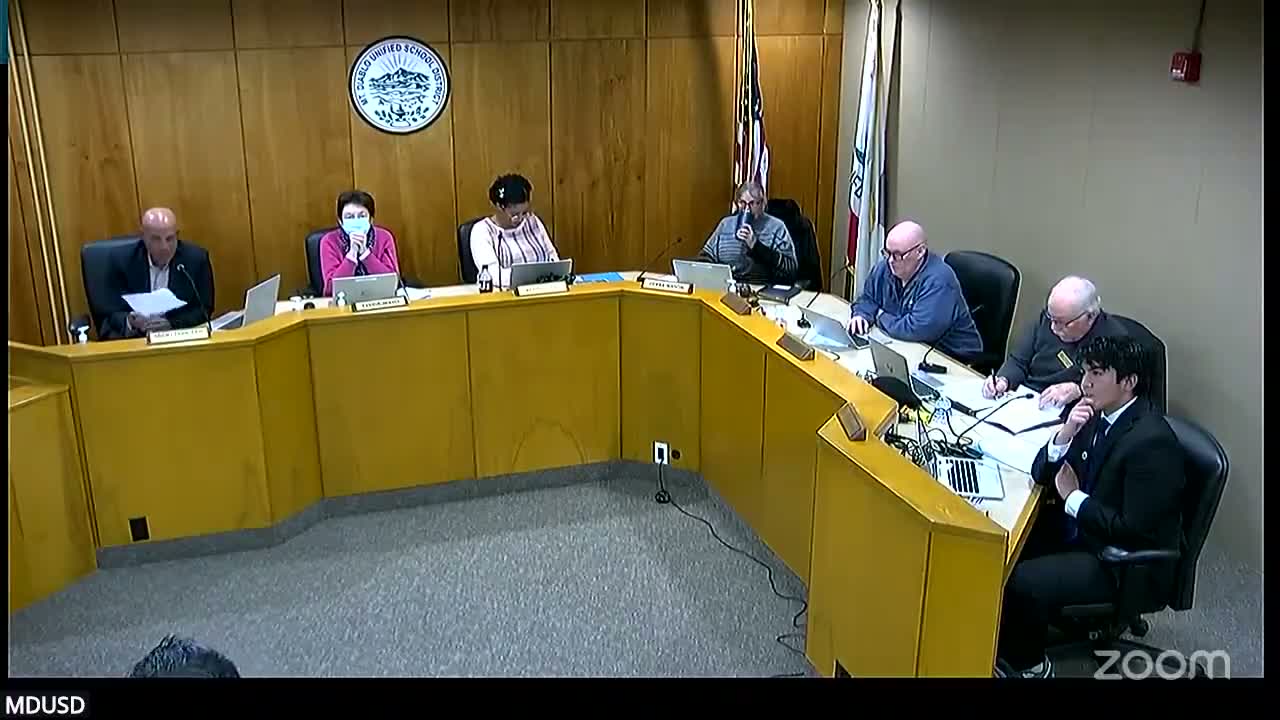
Summary
Finance staff told the board the governor’s January budget proposal reduces projected COLA, outlines several one‑time block grants (student support, learning recovery, universal meals), and could mean continued deficit spending; the district will model scenarios for its second interim report in March.
At the Jan. 21 meeting, Mount Diablo Unified’s chief business office provided a budget update focused on the governor’s January proposal and near‑term impacts for the district’s multi‑year projections.
Adrian Vargas summarized key elements from a January workshop in Sacramento and told trustees that prior COLA assumptions have fallen: earlier projections used higher COLA estimates but the governor’s proposal lowered those figures. Vargas also highlighted several one‑time allocations in the governor’s plan, including a student support and professional development block grant and a learning recovery block grant. He estimated the district could receive roughly $14 million from the student support block grant under current assumptions, stressing these are one‑time funds.
Vargas said the district uses three‑year multiyear projections for interim reports and noted staff will present a second interim budget on March 11 that models scenarios with and without the governor’s proposals. On the timing question, Vargas said the state’s May revise—expected around May 10–11—will provide an updated COLA estimate for 2026–27.
Trustees asked how the Legislative Analyst’s Office (LAO) projections compared with the governor’s. Vargas said workshop presenters contrasted the two viewpoints and that historically the LAO is more conservative while enacted budgets tend to follow the governor’s proposal; he warned that mid‑year adjustments remain a risk and that the district is intentionally using reserves to smooth impacts.
Why it matters: COLA and one‑time state funds materially affect the district’s ability to meet negotiated salary settlements, maintain staffing and fund programs. Vargas said the district is currently engaged in deficit spending to draw down reserves while trying to meet a 3% reserve requirement in the third year of projection.
What’s next: Staff will return with the second interim budget in March and will update projections after the May revise.