Get Full Government Meeting Transcripts, Videos, & Alerts Forever!
Get email alerts on the Wildfire Resiliency topic
No spam. Unsubscribe anytime.
Timnath staff recommends townwide Class 1 adoption of Colorado Wildfire Resiliency Code, Class 2 for orange zones
Summary
Town staff recommended Timnath adopt the state's Colorado Wildfire Resiliency Code with Class 1 requirements townwide and apply Class 2 only to higher-intensity orange zones, saying most new construction already meets Class 1 standards and that map amendments would be costly.
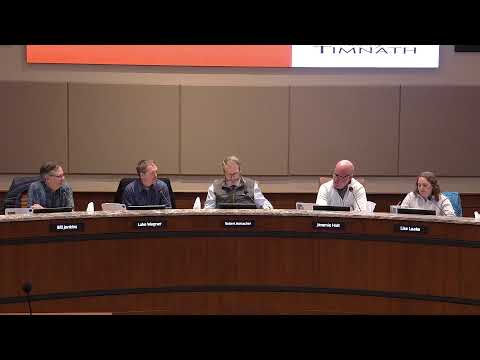
Town staff urged the Timnath Town Council on Feb. 10 to adopt the Colorado Wildfire Resiliency Code by the statewide deadline of April 1, 2026, recommending the town set Class 1 standards for the entire municipality while applying the stricter Class 2 standards only in the state-mapped orange (higher-intensity) areas.
Director Scott Robinson, who presented the overview, said the statewide code adopted in 2025 sets minimum design and material requirements intended to reduce structure ignition in the wildland-urban interface. He described the state's hexagonal intensity mapping and told the council that amending the state map to change local designations can cost roughly $200,000 in data collection and justification. "It's complicated and very expensive for us to go and amend the map," Robinson said.
Robinson said the new code applies mainly to new construction and, in some cases, to additions that meet threshold triggers. He emphasized that many of Timnath's current new-home building standards already align with Class 1 elements such as roof type, siding and venting. "If you go Class 1 for the entire town, I think that's a minimal cost and a pretty reasonable standard that I believe we're currently doing," he said.
Council members asked about how the code would affect historic Old Town structures, roofs, sheds and accessory dwelling units. Robinson said interior renovations are generally not covered; exterior work, new roofs, and sufficiently large additions typically trigger review. He also noted enforcement challenges for landscaping and fencing requirements, which are often handled at certificate-of-occupancy and through ongoing education and complaint-driven enforcement. "There's no additional state funding through the state for some of the enforcement," Robinson said, acknowledging concerns about an unfunded mandate.
The presentation also addressed possible insurance impacts. Robinson cautioned that insurers will review individual properties but could use the state's map and the standards a jurisdiction adopts when assessing risk. He provided an example figure from Larimer County estimating about $1,200 in one class-change scenario, but said material-change costs are the principal driver rather than major design alterations.
Robinson identified three primary local options: adopt the state minimum and keep the three tiers (Class 1/2/others); align with Larimer County's more stringent approach (Class 2 countywide); or adopt a hybrid that sets Class 1 townwide and applies Class 2 only in orange-mapped areas to maintain local consistency with the county where needed. He said staff will provide FAQs and cost estimates as follow-up materials and recommended an intergovernmental agreement with Cedar Valley Fire where appropriate.
Council members signaled they were comfortable with staff's hybrid recommendation and asked staff to return with FAQ documents, cost estimates and draft ordinance language ahead of the April 1 deadline. The council did not take a final vote on adoption during the Feb. 10 meeting.
The next procedural steps: staff will supply more detailed cost estimates and FAQs, coordinate with fire districts on enforcement and prepare draft ordinance language for council consideration before the April 1, 2026 adoption deadline.