Get Full Government Meeting Transcripts, Videos, & Alerts Forever!
Get email alerts on the Economic Development Tax Policy topic
No spam. Unsubscribe anytime.
Committee Hears Bill to Let R&D Tax Credits Stack With IRBs, Limit Transferability to $50M a Year; Substitute Tabled
Summary
A House committee reviewed a substitute for House Bill 27 to let certain research-and-development tax credits be used with industrial revenue bonds, allow limited transferability and extend carryforward to seven years; supporters said the changes would keep commercialization and jobs in New Mexico, while some members raised concerns about stacking, transferability recipients and fiscal exposure. The committee ultimately tabled the substitute.
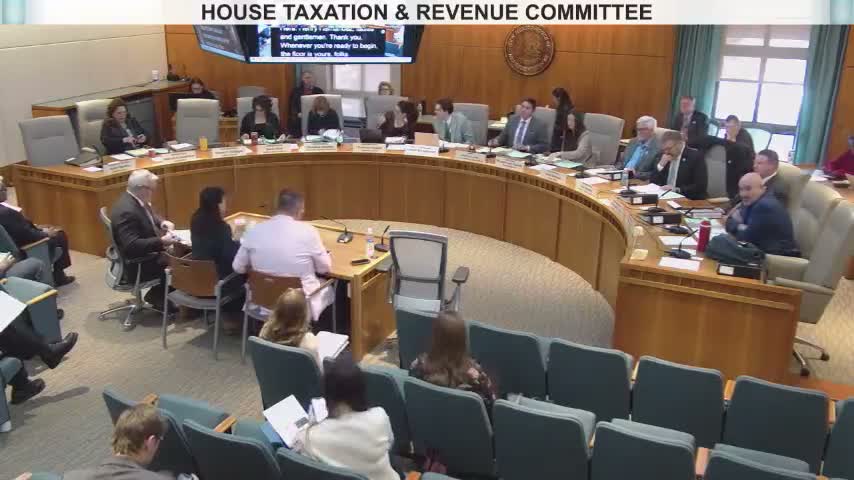
House lawmakers and agency witnesses spent nearly two hours debating a committee substitute for House Bill 27, a proposal to modernize New Mexico's Technology Jobs and Research and Development Tax Credit by allowing the credit to be stacked with industrial revenue bonds (IRBs), permitting limited transferability and extending the carryforward period to seven years.
Sponsor remarks and expert testimony framed the measure as a narrow economic development tool to keep research commercialization and high-paying jobs in-state. "House Bill 27 is a bill to modernize our high-tech research and development tax credit," a sponsor told the committee, noting the bill would expand eligibility to operations in facilities financed or housed using an IRB while explicitly excluding data centers and national laboratories.
The nut of the substitute is threefold: (1) allow qualified expenditures for projects hosted on property using IRBs to qualify for the R&D credit (making the credit "stackable" with IRB-based incentives); (2) permit transferability of credits, capped statewide at $50,000,000 of transferred credits in any year and limited to transfers executed in 2026, 2027 and 2028; and (3) lengthen the carryforward period so companies may claim credits for up to seven years. Secretary Rob Black of the Economic Development Department told the committee that tying credits to physical infrastructure makes it "much more difficult for [that investment] to leave," which supporters said encourages commercialization here.
Supporters from labor and industry said the change is targeted and time-limited. Lisonbee Riley of the New Mexico Chamber of Commerce said the bill "makes targeted, market driven improvements to an existing R and D tax credit by removing restrictions that currently force communities to choose between economic development tools." Jason Weeks of the New Mexico Tax Credit Alliance and Matt Paul of Pacific Fusion both said transferability and stacking will help early-stage companies convert tax credits into working capital so they can scale locally.
Fiscal and policy questions dominated member scrutiny. Committee members raised three main concerns: how the $50 million transfer cap will be allocated; whether transferable credits could be bought by companies outside the R&D sector (for example, dealers or other taxpayers with tax liability); and whether stacking IRBs with the R&D credit simply shifts tax breaks to projects without ensuring commercialization.
Taxation and Revenue Department officials described the cap as a statewide, first-come, first-served allocation and said the substitute's fiscal impact is smaller than earlier estimates once certain IRBs are excluded by date; Tax & Rev's analysis projected roughly $10 million in near-term impact with a potential peak near $48 million in a later fiscal year. The committee sponsor pointed out an earlier LFC/FIR range (which included certain large projects) of about $34 million to $70 million but said amendments could clarify intent and reduce exposure.
On the question of who could purchase transferred credits, Tax & Rev counsel explained that, in general, transferable credits can be sold to any taxpayer with the appropriate tax liability; there is no statutory requirement in the state's credits that the transferee operate in the same industry as the seller. "It need not be the same industry," an agency witness said, answering a member's hypothetical about car dealerships or other corporate buyers.
Several members asked why data centers are excluded. Sponsors and the secretary explained that data centers are not generally treated as conducting R&D and that the substitute clarifies existing practice rather than creating a new carve-out. Questions about whether national laboratories could access the credit were answered in the negative: sponsors said the bill explicitly prevents labs from qualifying, consistent with the intent to focus on private-sector commercialization.
Lawmakers pressed the administration on process and safeguards. Representative Parajon asked whether local IRB approvals include a "but-for" economic analysis; agency witnesses said local jurisdictions typically negotiate IRB terms and state agencies assist with economic-impact analysis, with discussions about pilot (payment-in-lieu-of-tax) terms and other local conditions. On the constitutional question raised by the State Ethics Commission, Tax & Rev staff pointed to precedent for transferability in recent bills and said transferability itself is not, on its face, an anti-donation violation when credits are certified based on qualified expenditures for research performed.
Several representatives also sought more granular information about stacking precedents and a list of which credits currently stack with IRBs; Tax & Rev agreed to provide a list after the hearing. Rural-area incentives remained intact under the substitute, agency staff confirmed, and staff described site-readiness efforts and a pipeline of characterized sites intended to broaden geographic reach beyond the I-25 corridor.
The hearing included multiple support witnesses representing labor, utilities, industry and environmental groups. The Building and Construction Trades Council said the bill "means more construction projects, more hours for skilled workers, and more paychecks for New Mexico families." The Clean Air Task Force offered support for fusion-related supply-chain opportunities.
After the question-and-answer period and final remarks from the sponsor and chair, Vice Woman Querrera moved to table the committee substitute for House Bill 27; Representative Parajon seconded the motion. The chair stated, "Seeing no opposition, this bill has been tabled." The motion was recorded as passed by voice vote and the committee took no further action in the hearing.
The next steps mentioned by presenters included technical amendments to clarify IRB eligibility language and continuing work with committee staff on fiscal technicals; Tax & Rev and the sponsor said they would provide additional documents (examples of stacking rules and a statutory list of stackable credits) to committee members.
What to watch: whether the sponsor adopts clarifying language on IRB eligibility (for example, specifying whether IRBs "originally issued" before a given date are excluded from transferability), the final fiscal-impact assumptions adopted by the Legislature, and whether the Senate side develops capacity or offset proposals that influence House willingness to advance the substitute.