Get Full Government Meeting Transcripts, Videos, & Alerts Forever!
Get email alerts on the Ev Fleet topic
No spam. Unsubscribe anytime.
Richfield City work session: study names 24 light-duty vehicles as near-term EV candidates
Summary
A Sawatch Labs study presented at a Richfield City Council work session identified 24 light-duty municipal vehicles as near-term candidates for conversion to battery-electric models, estimated roughly $140,000 in lifetime total-cost-of-ownership savings and projected a reduction of about 787 tons of greenhouse gases; staff recommended phased charging infrastructure, leasing options and further finance analysis before purchases.
Richfield City staff presented results of a Sawatch Labs fleet analysis at a Jan. 27, 2025, work session, saying the study identified 24 light-duty municipal vehicles as near-term candidates for conversion to battery-electric vehicles (EVs).
"We we do have 254 vehicles in our fleet," an operations staffer said during the presentation, and staff reported 68 of those were studied in detail with 62 light-duty and 6 medium/heavy vehicles among the sample. Of the 68, staff said 24 were recommended for EV conversion based on economics, energy use, parking and data confidence.
The presenters said the study ran from mid-October 2024 through January 2025 to capture a range of seasonal driving conditions. Staff attributed an estimated lifetime total-cost-of-ownership (TCO) savings of about $140,000 to converting the recommended vehicles and a greenhouse-gas emissions reduction on the order of 787 tons across the modeled replacements.
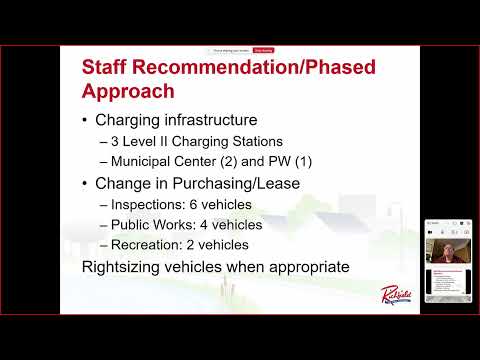
Presenters noted the study scored each vehicle and produced a one-page profile with parking location, operational-cost difference and suggested replacement model. That per-vehicle data allowed staff to estimate charger demand and the likely charger level; staff said the consultant recommended Level 2 chargers for the majority of candidate vehicles and highlighted that the top parking locations for candidates are the City Hall complex and Public Works.
Staff cautioned that one-off outlier trips in the study periodfor example, occasional out-of-state conference travelcan skew results. "If a car was taken for an out-of-state conference once during this time period, that once trip might have switched the numbers enough to make it seem like it's not a good vehicle for EV candidacy," the presenter said, and staff proposed a follow-up review to remove such outliers and re-evaluate marginal candidates.
On public-safety vehicles, staff clarified that patrol and police pursuit cars were included in the dataset but generally ranked lower for EV suitability; a small number of police vehicles appeared in higher rankings, but staff said most pursuit cars did not meet current operational and TCO tests. Presenters recommended staff prioritize charging infrastructure and assess leasing models before committing to large upfront purchases.
Council members raised practical concerns during questions: the rotation and replacement cadence of vehicles (age, mileage and maintenance rather than a fixed annual number), whether manufacturer support for specific EV models might lapse, and whether EVs could be used during extended power outages. Staff said portable generators and building generators exist at some municipal sites, that the recommended candidate vehicles would generally be lower-priority during outage response, and that leasing could mitigate risks if manufacturers discontinue models.
Next steps staff described included: a finance-led analysis of leasing versus purchase and total lifecycle costs; an electrician-led site assessment to estimate installation costs and electrical capacity at City Hall and Public Works; right-sizing of vehicle classes (reducing unnecessary 4WD where appropriate); and a second-phase data review to remove identified outlier trips and reassess near-term candidates. No formal motions or votes were taken during the session.
The work session concluded after questions and the council chair adjourned the meeting.