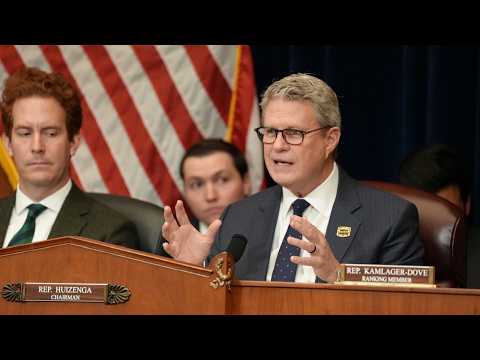
Opening remarks at House hearing call for stronger U.S. strategy in South and Central Asia

House Committee on Foreign Affairs · February 11, 2026

Get AI-powered insights, summaries, and transcripts

Subscribe
AI-Generated Content: All content on this page was generated by AI to highlight key points from the meeting. For complete details and context, we recommend watching the full video. so we can fix them.

Summary

An opening speaker at a House Committee hearing framed South and Central Asia as central to U.S. security and economic interests, warned about China's influence through the Belt and Road Initiative, highlighted the Indian Ocean's strategic role, and urged deeper ties with India; the speaker invited Assistant Secretary Kapoor to present detailed administration policy.

Speaker 1 (role/title not specified) opened the hearing on U.S. policy toward South and Central Asia, calling the region —one of the most important— for American national security and economic strength and urging a comprehensive, partnership-driven strategy.

"South and Central Asia is home to nearly 2,000,000,000 people, dynamic economies, and strategic waterways that shape the balance of power in the Indo Pacific," Speaker 1 said, arguing that how the United States engages will shape its role in Asia for decades. He portrayed stronger diplomacy and economic engagement as tools to compete with China and to reinforce partnerships.

Speaker 1 criticized China's approach in the region, stating that "through its Belt and Road initiative, China engages in predatory lending to further its security interests and force smaller nations into debt traps." He also raised concerns about infrastructure activity along China's borders with India, Nepal and Bhutan, saying it appeared tied to "military aspirations."

On maritime security, the speaker stressed the strategic importance of the Indian Ocean, calling it a critical commercial corridor and saying it carries "more than 80% of global seaborne oil trade." He urged enhanced naval cooperation with allies to safeguard sea lanes and counter what he described as China's growing influence.

Speaker 1 praised the U.S. naval presence at Diego Garcia and argued that sustaining that presence would help deter coercion, prevent piracy and protect trade.

Turning to bilateral ties, Speaker 1 described India as a key strategic partner and said that strengthening relations through defense cooperation, trade and technology partnerships would advance shared interests. He asserted that a recently negotiated U.S.-India trade framework would lower tariffs and increase India's purchases of American energy; those claims were presented as the speaker's account and were not substantiated within the hearing record.

Speaker 1 also referred to political changes in the region, saying Bangladesh would hold elections "tomorrow" after a —20 24 July revolution— and that Nepal's youth had recently overthrown the government with elections planned "next month." Those statements were presented by the speaker as context for increased U.S. engagement but were not verified during the proceeding.

The speaker concluded by inviting Assistant Secretary Kapoor to present the administration's South and Central Asia strategy.

The hearing then moved to testimony from Assistant Secretary Kapoor; no formal votes or motions were recorded during these opening remarks.