House Revenue Committee keeps long-term homeowners exemption, adds implementation changes and caps high-end benefit
Loading...
Summary
The committee removed the sunset on House Bill 45 to make the long‑term homeowners property tax exemption permanent, moved claimant notification to March 1 to appear on the April assessment notice, added language to credit months lived in two owner-occupied homes toward eligibility, and approved a $3 million fair‑market-value cap; final committee vote passed 7–0 with two conflicts.
The House Revenue Committee on Feb. 10 voted to advance House Bill 45 with several amendments that make the long‑term homeowners property tax exemption permanent and change how it will be administered.
Ken Gill, administrator of the Department of Revenue’s Property Tax Division, told the committee the bill removes the statutory sunset that would otherwise end the exemption after tax year 2026 and moves the notification requirement to county assessors by March 1 so the benefit appears on the April notice of assessment rather than only on the later tax bill. “It gets rid of the sunset,” Gill said, and shifting the date means “the exemption will be on the notice of assessment that gets sent out in April.”
Converse County assessor Dixie Huxtable, representing the county assessors association, said the March 1 reporting date will improve office efficiency and taxpayer transparency. Huxtable described a one‑page affidavit used this year and said the bill’s phone‑reporting option will reduce paperwork: “Allowing them to call us would be a huge benefit,” she said, while cautioning assessors cannot always verify the identity of someone calling on another person’s behalf.
Committee members spent substantial time resolving two recurring issues: how to treat owners who sell one qualifying home and buy another in the same year, and whether the exemption should be limited in scale. Representative Brown offered — and the committee adopted — language that credits months residing in both owner‑occupied homes toward the eight‑month eligibility test so the exemption effectively “follows the person” for qualification purposes. Assessors and the Department noted proration of the actual exemption amount across two properties is typically handled contractually at closing and by title companies; the bill clarifies qualification rather than prescribing the closing‑table proration mechanics.
Representative Storer successfully proposed an amendment to cap the exemption so it applies at 50% of the first $3,000,000 of fair market value, a change aimed at reducing very large tax benefits for high‑value properties in markets such as Teton County. Members debated whether to express the cap in assessed value or fair market value before adopting the cap in committee.
The panel also debated removing the age‑65 qualifier that had limited the exemption to older residents; Representative Lean’s amendment to strike the age requirement initially passed by voice vote. Later in the same session the committee voted to restore the age‑65 language for this iteration of the bill, citing budget calibration and simplicity concerns.
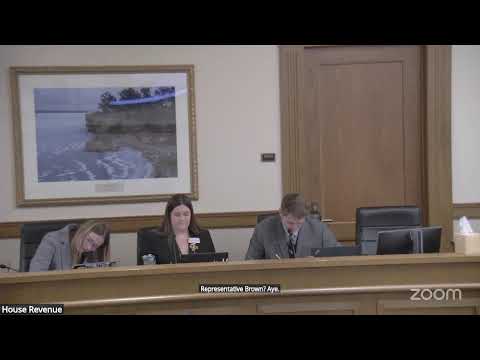
On a roll‑call vote to advance House Bill 45 as amended, the chair recorded seven ayes and two conflicts and declared the bill passed out of committee. The Department of Revenue estimated the exemption’s statewide reduction in taxable value at about $45,500,000 for tax year 2025, and staff told members roughly 29,000 claimants had preregistered this year while just under 35,000 used the exemption statewide last year.
What happens next: the bill was reported out of the House Revenue Committee for further consideration. The committee’s amendments focus on implementation details — notification timing, qualification credit for owners who change homes within a year, and an explicit cap on the exemption amount — while leaving final proration mechanics to closings and title companies, which the Department and assessors said is the usual practice.
Sources: committee hearing testimony from Ken Gill (Department of Revenue), Dixie Huxtable (Converse County assessor), Todd Ernst (Laramie County assessor), and multiple House members during the Feb. 10 committee meeting.