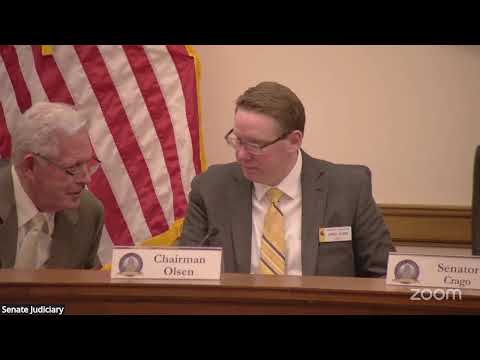
Committee approves permissive contracts and reimbursement for county detention centers to hold and treat mentally ill detainees
Loading...
Summary
Senate File 10 authorizes the Department of Health to designate and reimburse county detention centers to hold and treat Title 7 detainees awaiting state hospital services; the Department and sheriffs said the measure could reduce wait lists and 'warehousing' of ill detainees, and a reporting amendment was accepted.
The Senate Judiciary Committee moved Senate File 10 after hearing an overview from the Wyoming Department of Health and supportive testimony from sheriffs and other witnesses. The bill creates a permissive authority allowing the Department of Health to designate county detention facilities for holding and treatment of individuals under Title 7 and to reimburse counties for security and some treatment activities. Chair Olsen said the bill establishes a new statutory provision and listed July 1, 2026, as the bill's effective date.
Stefan Johansson, director of the Wyoming Department of Health, and Reagan Latham, senior administrator of the department's behavioral health division, told the committee the state faces three main challenges: volume of court orders for evaluations and admissions (roughly 40 outpatient evaluation orders and 10 inpatient orders per month), limited state hospital capacity (a 104-bed facility with about a quarter of beds reserved for forensic clientele) and workforce shortages for direct-care staff. The department described pilot efforts including telepsychiatry partnerships and an existing MOU with Laramie County Detention Center.
Alan Thompson (WASCOP) called SF 10 "the single most important bill for our sheriffs this session," saying permissive contracting and reimbursement could help jails of varying sizes provide treatment and reduce wait times and bed pressure at the state hospital. Senators asked about coordination among counties, the role of boards of county commissioners (which hold general-fund authority), rural capacity limitations and court-designated facilities; witnesses said county-level agreements and sheriff-commissioner coordination would govern logistics and that funding could pay for extra personnel where needed.
Senator Crago offered a friendly amendment requiring the Department of Health to report to the Judiciary Committee within a year on program use and inter-county coordination; the amendment was adopted by voice vote. The committee then voted to move the bill; the clerk recorded the result and the committee adjourned.