Get Full Government Meeting Transcripts, Videos, & Alerts Forever!
Get email alerts on the Book Bans topic
No spam. Unsubscribe anytime.
Harford County board removes graphic novel 'Flamer'; dozens of parents, librarians and students urge reinstatement
Summary
After the Board of Education voted to remove Flamer from school libraries, 88 speakers flooded the meeting with opposing views: some called the book vulgar and inappropriate for middle school, while librarians, teachers and LGBTQ advocates said the reconsideration committee followed policy and the book offers life‑saving representation.
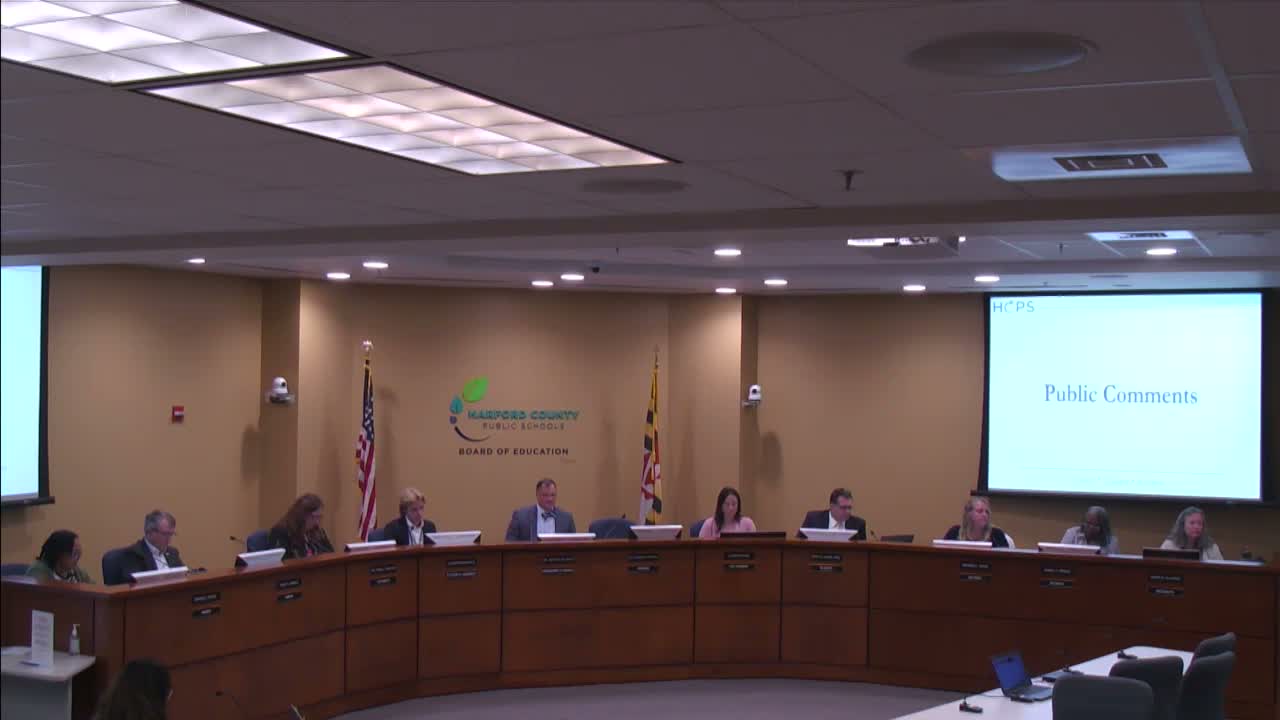
The Harford County Board of Education voted at its Aug. 18 business meeting to remove the graphic novel Flamer from school libraries, prompting more than an hour of public testimony from residents, librarians and students. Dozens of speakers urged the board to reverse the decision; others defended the removal as a matter of age appropriateness.
Supporters of reinstatement told the board the district’s review committee had read Flamer in full and found literary and educational value. Caitlin Hurley, a HCPS librarian and member of the reconsideration committee, said the panel "followed legal precedent, district policy, and the Maryland Right to Read Act and found that Flamer has clear literary and educational value." Several speakers read brief excerpts and said the story addresses bullying, identity and despair in ways that could help struggling students.
Opponents said the book contains graphic language and images they consider unsuitable for middle‑school shelves. School board members and the superintendent countered that the district’s materials‑review procedures consider age appropriateness; Superintendent Dr. Pointon said the board "acted fully within both the procedure and the law" and framed the decision as applying profanity and grade‑level standards rather than as censorship.
The public comment period featured a wide cross section of voices: retired teachers and professional librarians who urged honoring the panel’s recommendation; parents and students who said removing the book erases vulnerable students; and callers who described explicit passages and argued the title should not be freely accessible to students as young as 10 or 11.
The board did not immediately vote to reinstate the title during the meeting; board members said they would work with administration to review procedures. Dr. Pointon acknowledged concerns about the review process and said he would collaborate with trustees on potential fixes, while reiterating that removal was based on the district’s standards for grade‑level appropriateness.
The decision has also invited legal and statutory references: public commenters cited the "Freedom to Read Act" and court precedents about school library removals; librarians referenced Mueller v. California and similar cases arguing that a work must be judged as a whole when assessing obscenity or pervasive vulgarity.
Next steps: the board signaled it will continue discussions about the review process and policy implementation. Community members who addressed the board asked for a clear, public explanation of the legal and procedural basis used in the decision and urged the trustees to reconsider the removal.
(Reporting note: the meeting transcript alternates spellings of the district in places; the official name is Harford County Public Schools.)