Philadelphia hearing lays out tangled‑title crisis, legal aid push and funding shortfalls
Loading...
Summary
City officials, legal aid groups and researchers told a Council committee that at least 10,000 Philadelphia households likely live with tangled property titles, blocking access to insurance, tax relief and repairs; advocates urged more funding for probate costs, expanded tangled‑title fund caps and state law changes to clear titles more efficiently.
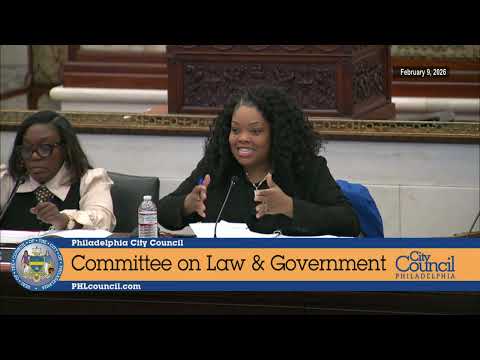
Philadelphia City Council’s Law & Government committee heard extended testimony on efforts to resolve “tangled titles” on Feb. 12, as registrars, housing officials and legal aid groups laid out the scale of the problem and the funding and legal changes they say are needed to speed resolution.
Chair Gilmore Richardson opened the hearing by citing local data and national research showing the stakes for long‑term homeowners and families who lack clear deeds. “Tangled titles is an issue that, personally, we’ve experienced in my family,” the chair told the panel as she described the process as “time consuming, expensive and frustrating.”
Register of Wills John Sabatina described a Title Clearance Unit his office created to coordinate probate assistance, legal referrals and deed recordings. Myasia Williams, who manages the unit, said the office has cleared 118 titles in a little over a year but cannot scale services without funding to cover probate costs—often cited in the hearing as roughly $400‑$1,000 per case. “We are free of charge, so our services are free,” Williams said. “We just really need the funds because statutorily the register of wills cannot waive probate fees.”
City officials and legal providers cited the Pew Charitable Trusts estimate that at least 10,000 Philadelphia households are affected and that the aggregate property value at stake exceeds $1.1 billion. Philadelphia’s Department of Records Commissioner James Leonard told the committee the administration supports state measures such as the Uniform Partition of Heirs Property Act and transfer‑on‑death deed legislation to prevent future tangles and to provide remedies for co‑owners. He also reported program metrics: outreach events since 2023, more than a dozen community engagements and, in fiscal 2025, legal aid partners completing about 275 successful title transfers and preparing 530 wills.
Representatives of Philadelphia Legal Assistance, Community Legal Services, Senior Law Center and Philadelphia VIP described the current intake and remediation pipeline: hotline triage (managed by Philadelphia Legal Assistance), neighborhood advisory committee pilots that offer local intake, and a tangled‑title fund run by Philadelphia VIP that covers costs such as title reports, probate filing fees and, where applicable, transfer taxes. Kelly Gastly of Philadelphia VIP said the Tangled Title Fund distributed more than $400,000 to nearly 300 low‑income applicants in 2025 and that rising property values are driving up requests, particularly for transfer‑tax relief.
Advocates pressed for several changes. Roxanne Crowley of Philadelphia Legal Assistance asked state lawmakers to permit heirs who possess and maintain property to obtain title against distant cotenants in certain circumstances (a narrower adverse‑possession carve‑out), and suggested loan products or a council‑level carve‑out for “air buyouts” so residents can buy out uncooperative heirs without prohibitive private capital. Senior Law Center urged expanding the estate‑exemption rules so heirs who inherit properties subject to mortgage do not lose transfer‑exemption protections.
Council members focused questions on how residents are identified and referred, whether there is an intake “cheat sheet” for families, and what specific additional resources would allow agencies to scale. Committee members heard that outreach and education — including funeral‑home notifications, community mailings and NAC pilot work — are part of prevention but that funding for probate costs remains the immediate bottleneck to scale up case closures.
The committee did not take formal votes on the tangled‑title matters at the hearing, but members repeatedly signaled support for further data sharing, coordination among the Register of Wills, Department of Records and DHCD, and potential council action to adjust the tangled‑title fund and related administrative processes.
What’s next: Council staff and the agencies on the panel agreed to continue sharing data and follow up with written answers to outstanding technical questions. Several lawmakers said they plan to work with state delegates on adverse‑possession and transfer‑on‑death deed reforms.