Get Full Government Meeting Transcripts, Videos, & Alerts Forever!
Get email alerts on the Municipal Budget topic
No spam. Unsubscribe anytime.
Preliminary FY27 budget shows $6.6 million gap as school debt, insurance and pensions bite
Summary
An unidentified presenter told officials the town faces a $6.6 million funding gap in its preliminary FY27 budget driven by rising health insurance, pension commitments and debt service tied to a $70 million high school borrowing; staff will meet departments to prioritize spending.
An unidentified presenter outlined North Attleborough’s preliminary fiscal 2027 budget, saying the town faces a $6,600,000 funding gap driven by rising health insurance costs, pension obligations and new debt service for the high school project.
The presenter said the proposal asks for the full 2.5% levy increase under Proposition 2½ — roughly $1.8 million — and that assessor Cheryl Smith has pegged new growth at about $800,000, combining to roughly $2,600,000 in levy growth under current assumptions. State aid, the presenter said, is ‘‘essentially flat.’’
The presenter described a debt exclusion totaling about $4,178,760 tied to a $70,000,000 borrowing for the high school project and said that debt exclusion will appear on tax bills starting in January. He emphasized that debt-exclusion receipts are earmarked to service the debt for which the exclusion was created.
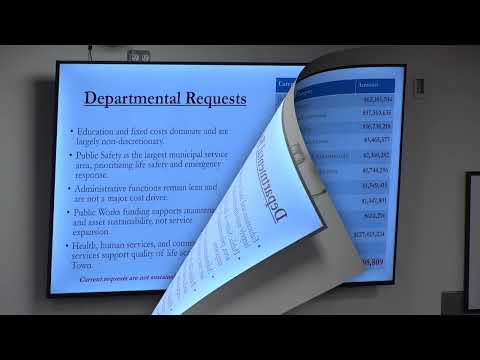
Officials begin FY27 deliberations with a starting budget figure of $120,814,415, the presenter said, and noted that education and fixed obligations account for the largest share of spending, much of it nondiscretionary. Public safety is the largest single municipal service in the operating requests.
On cost drivers, the presenter said health insurance costs are projected to rise 10–15% and identified a $2,200,000 shortfall tied to those projected increases that contributes to the funding gap. He said pension contributions follow a prior plan to increase by 8% year over year to satisfy obligations by 2035, which limits budget flexibility. Cashflow strain was also noted: the presenter said the town is running at about 109% in at least one measure, with a monthly payment near $1,600,000 and one month at roughly 140%.
The presenter said the town will not propose any new full-time positions this year; the proposal does not include new full‑time roles, only benefit changes to part-time positions. For capital, staff are preliminarily considering about $3,000,000 of borrowing based on current capacity.
Next steps, the presenter said, are a ‘‘coordination, deliberation and reconciliation’’ phase in which department heads will be asked what they can do without, what they need and what they want, with prioritization expected to focus on maintenance and infrastructure. The presenter closed by characterizing this as a preliminary budget to guide that work and the effort to produce a balanced budget that meets statutory requirements.
The presentation did not include any formal motions or votes; officials were advised that further meetings with department heads will determine final proposals and any formal actions to adopt or amend the budget.