
Experts urge unified modeling and county well-permitting guidance to limit streamflow depletion
Get AI-powered insights, summaries, and transcripts
Subscribe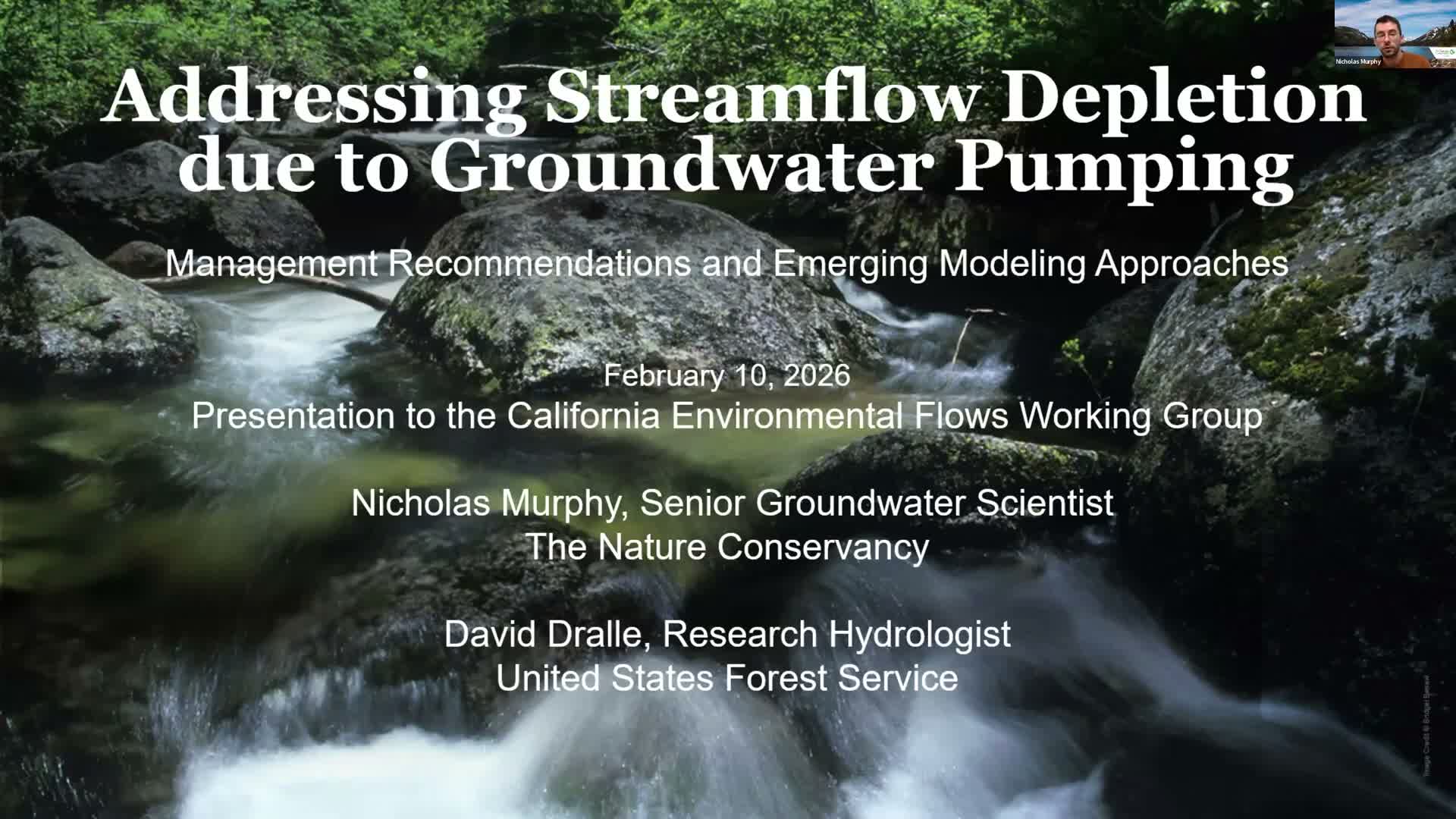
Summary
Presenters told the Environmental Flows Work Group that counties need clearer technical guidance, low-cost decision-support tools and funding to evaluate streamflow depletion from groundwater pumping under SGMA and public-trust court precedents.
Experts advising California counties on groundwater permitting said protecting streamflow and associated habitat requires both better models and clearer regulatory guidance, citing the Sustainable Groundwater Management Act and recent court rulings as drivers of change.
Nicholas Murphy, senior groundwater scientist for The Nature Conservancy, told the California Environmental Flows Work Group that groundwater is a key source of summer baseflow and that "groundwater is streamflow." He described a five-step guidance workflow his coalition recommends for county permitting: identify public-trust resources; set protective streamflow thresholds; assess existing streamflow against those thresholds; use integrated surface-water/groundwater models to estimate depletion risk; and translate results into revised well ordinances and permitting procedures.
Why it matters: groundwater-fed baseflows sustain rearing habitat for salmonids and other groundwater-dependent ecosystems. Murphy and collaborators said failing to account for pumping-driven depletion can negate restoration investments and leave streams dry in summer when fish need habitat most.
Regulatory context and local responses: Murphy framed the recommendations against two parallel legal frameworks. He said the Sustainable Groundwater Management Act (SGMA), passed by the Legislature in 2014 and implemented starting in 2015, requires groundwater sustainability plans to avoid specified 'undesirable results' by 2040, including depletion of interconnected surface waters. He also described the 2018 Scott River court decision, which established that counties must consider public-trust resources when permitting new wells; as a result, Sonoma County updated its well ordinance in 2023 and Santa Cruz County initiated a process that was completed in 2025.
Modeling and technical trade-offs: presenters emphasized that quantifying streamflow depletion at watershed or basin scales typically requires models. David Drawley of the U.S. Forest Service said depletion is fundamentally a counterfactual problem — "what would the streamflow have been without pumping?" — and that the right modeling approach depends on landscape type. For relatively flat, depositional basins, the team has used analytical depletion functions (simplified equations); for steep, bedrock-dominated hillslopes they are developing hillslope or Boussinesq-style models that capture steep water tables and fractured-rock storage.
Presenters cautioned that high-fidelity integrated models are expensive and data-intensive. Murphy said counties need low-cost, lower-complexity decision-support tools for places without dense monitoring networks and urged statewide funding and technical assistance to support well-ordinance revisions and implementation. He noted gaps in well-location and abstraction databases and flagged abandoned or orphaned wells as a locally relevant but generally understudied factor.
Questions from attendees addressed data-poor watersheds, climate change, managed recharge and cumulative impacts. Panelists recommended acknowledging uncertainty explicitly (applying precaution when data are lacking), incorporating vegetation and evapotranspiration responses into scenarios for hotter, drier futures, and using comparative model scenarios (pumping on/off) to assess relative impacts.
What comes next: presenters and participants said work will continue on a suite of tools matched to landscape context, and called for collaborations between local GSAs, state agencies and technical partners to supply data, funding and standardized guidance. The Environmental Flows Work Group will continue discussion at its next meeting on May 12; slides and the recording will be posted to the work group website.