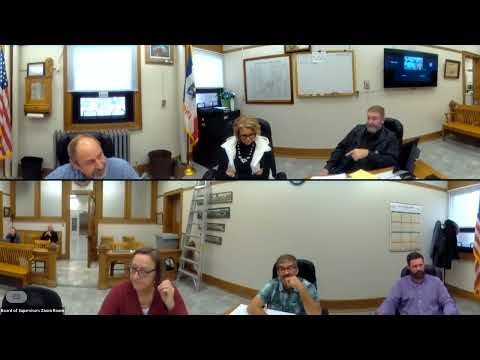
Crawford County board opens public hearing on making EMS an essential service; hospital and volunteers press for details
Loading...
Summary
The Crawford County Board of Supervisors held an extended public hearing on Feb. 3, 2026 to consider declaring emergency medical services (EMS) an "essential service," which would allow a county property levy or local income surtax to fund a countywide EMS system. Hospital leaders, volunteer crews and residents urged clearer operational plans before voters are asked to approve a tax.
The Crawford County Board of Supervisors on Feb. 3 opened a lengthy public hearing on whether to declare emergency medical services an "essential service," a designation that — if approved by voters — would allow the county to levy a property tax (up to $0.75 per $1,000 of assessed value) or a local-option income surtax (up to 1 percent) to support EMS operations.
Zach Rasmussen, the county emergency management coordinator and a member of the task force drafting the plan, told the board the statutory framework requires a ballot measure and sets a 15-year period for the levy, with a 60 percent voter-approval threshold. "At the $0.75 per thousand level, it generates a little over $1,000,000 for services," Rasmussen said, summarizing figures from a draft budget prepared by the task force.
Why it matters: County officials and volunteers say the current mix of hospital-run ambulance service and several volunteer squads is under strain. Supporters say a dedicated, county-funded framework would stabilize staffing, expand training and provide predictable funding for volunteers and transport services. Opponents and some hospital leaders said they need a clearer operational plan before voters are asked to fund a long-term levy.
Hospital leaders attending the hearing said the hospital remains committed to prehospital care but asked for more detail on how a county system would affect current services and hospital finances. A hospital representative said the hospital "is still planning on running an ambulance" while discussions continue about how county and hospital responsibilities would interact.
Several volunteers and long-time EMS professionals urged the board to move carefully but said sustainability is the central concern. Mackenzie Reese, president of the local EMS Association and an EMS employee, told the board that staffing levels are strained and that formalizing a county system could improve recruitment, training and retention. Retired health-care executive Bill Bruce urged caution on timing and planning: "This hearing is getting the cart well before the horse because I haven't seen an operational plan," he said.
Budget and mechanics discussed: Rasmussen and the task force outlined a draft budget and said the levy could be structured as a property levy and/or income surtax. The draft also proposed an advisory council and a multi-year plan for allocating revenue across volunteer and hospital-provided services. Task-force materials presented to the board showed a planning-level number roughly described as about $1.9 (interpreted in meeting materials as approximately $1.9 million) for a proposed multi-year funding picture; presenters said those figures are draft and subject to revision during further public meetings.
Hospital finances and current subsidy: Hospital representatives said their ambulance operation runs at a significant loss after billing revenue — the hospital cited an operating shortfall in the hundreds of thousands of dollars annually and asked for fiscal clarity if services are centralized under a county levy. Hospital speakers requested a formal operational plan describing quality controls, staffing models, and whether the hospital would continue to operate an ambulance under the proposed county model.
Next steps: After hours of testimony and questions from supervisors, the board closed the hearing and scheduled a follow-up public hearing for April 7, 2026, at 10:00 a.m. in the Board of Supervisors meeting room. Board members asked county staff and the task force to bring clearer operational details, specific cost-sharing proposals with the hospital, and options that show how volunteer services would be supported.
What was not decided: No final tax or levy level was set; no binding operational transfer of services was approved. The board underscored that any tax would require voter approval and that specific levy levels and program structure will be further developed and presented to the public before any ballot placement.
Reported by: Zach Rasmussen and public commenters at the Feb. 3, 2026 Crawford County Board of Supervisors meeting. The board set a second public hearing for April 7, 2026.