
Clinton board adopts revised wetlands local law after public hearing; resident warns of legal and cost risks
Get AI-powered insights, summaries, and transcripts
Subscribe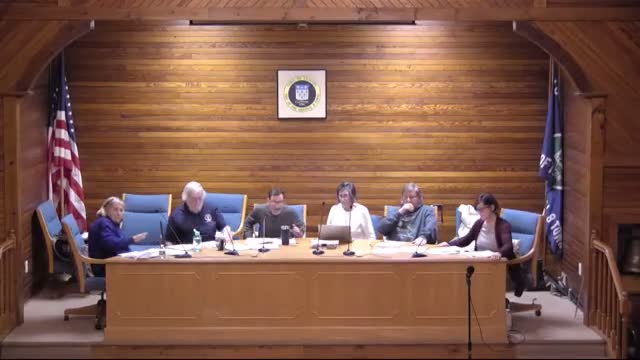
Summary
After a lengthy public hearing, the Town of Clinton board approved Local Law No. 1 of 2026 revising freshwater-wetlands regulations. A resident warned the draft removes a planning-board waiver, could increase permitting costs and invites legal challenges; the board approved the measure as amended.
The Town of Clinton Board voted Feb. 10 to adopt Local Law No. 1 of 2026, updating the town—ode on freshwater wetlands, buffers and floodplains, after a public hearing that drew extended testimony from residents urging further revision.
At a public hearing opened by the town supervisor, board member Catherine King introduced the revision and said it was intended to recalibrate local rules to reflect changes in what the New York State Department of Environmental Conservation will regulate. King also said a last-minute amendment would remove a paragraph identified in the draft as "F5."
Resident Fyridine Schilling, who identified herself as living at 99 Willow Lane, urged the board not to adopt the law as drafted. Schilling said the revision deletes a planning-board waiver contained in section H of the existing code and replaces it with a mandatory referral process to the zoning board of appeals. She said that change would force routine, small projects into a lengthy variance process and cited a recent local case where a homeowner spent about $14,000 under the existing process. Schilling said the proposed change could raise typical compliance costs to roughly $25,000 because a wetland delineation, engineer, planner and attorney would be required to seek a variance. She also flagged penalties in section K that she read as allowing fines up to $15,000 per day for continuing violations and said the town—ould face an Article 78 challenge in state court if the law is internally inconsistent.
"By deleting section H, you are removing the planning board's ability to say this activity is inconsequential," Schilling said, arguing the town is using an older Hudsonia predictive map incorporated in the Clinton 2024 NRI in a way she said is inappropriate for site-level legal determinations.
Board members and staff discussed enforcement practicalities and map accuracy during the meeting. Town staff noted options to procure a GIS service to allow more accurate parcel-level review and to provide mapping tools to the zoning administrator. The board discussed the balance between applying state standards and preserving local flexibility for minor projects.
Following discussion, the board moved to adopt the local law "as amended" (King s mover; motion seconded). The motion carried by voice vote. The board also recorded earlier procedural actions: opening and closing the public hearing before the regular meeting.
The final local law text, as adopted, was described at the meeting as an amended draft with paragraph F5 removed; the record shows the law was proposed with reference to the January 2025 updates to Article 24 of the New York State Environmental Conservation Law but residents at the hearing argued the town dds additional requirements beyond state standards.
Next steps noted at the meeting: the town will need to ensure the zoning administrator has access to accurate parcel-level GIS tools for implementation; residents concerned about specific parcels may pursue delineations or administrative appeals, and any legal challenge to the local law would be resolved in state court.
The board completed adoption during the regular meeting later that night.