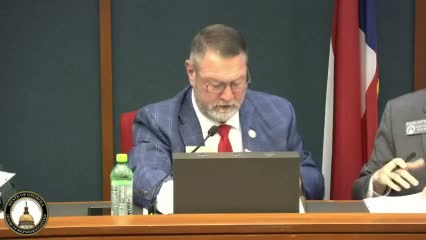
Committee advances bill to create grant program for ballistic glass in patrol cars
Loading...
Summary
A House committee passed a bill to let law‑enforcement agencies apply to a CJCC grant program to retrofit patrol vehicles with ballistic glass, after hearing testimony from a sheriff, a nonprofit that ran a Texas program and officers who said the glass saved lives; the program is subject to appropriations.
A Georgia House committee advanced a bill to allow law‑enforcement agencies to apply for state grants to install ballistic glass in patrol vehicles, with the Criminal Justice Coordinating Council (CJCC) to set grant criteria and distribution rules.
Representative Jordan Ridley, sponsor of House Bill 9 67, told the committee the two‑page bill creates a grant program through the CJCC and makes awards 'subject to appropriations.' 'If the state has extra money and they want to invest in it, the council can get the money and give out those grants,' Ridley said.
Sheriff Henson of Paulding County described the 08/17/2024 killing of Deputy Brandon Cunningham during a domestic‑call response and urged funding to provide cover for deputies. 'If we don't have public safety, you don't have one single thing that works in this country,' he told the committee.
Dr. Clifford Dorn of Operation SafeShield, a Texas nonprofit, described Texas' experience equipping vehicles after high‑profile attacks on officers. Dorn said Texas appropriated about $25 million in the first year and another $27 million later, and that his group has helped equip more than 150 vehicles. He described the retrofit as typically meeting NIJ level IIIA standards for handgun protection and estimated a retrofit cost 'about $10,000 a vehicle' (approximate).
Keith Bitts, a deputy who said he survived a 05/31/2025 ambush because his vehicle had ballistic glass, gave a firsthand account and urged the committee to approve a grant program. 'I'm alive today because I had ballistic glass,' Bitts said.
David Cavender of Dana Safety Supply, a vendor referenced by witnesses, offered to answer procurement questions; he told the committee that demonstrations and local incidents suggested the glass can change outcomes. Committee members asked about grant denial criteria, rating levels, and whether smaller or rural departments would be disadvantaged; sponsors said the CJCC would set criteria and that the bill does not itself appropriate funds.
A motion to pass House Bill 9 67 was made, seconded and carried in committee; the bill advances subject to appropriations and CJCC rulemaking.