
Committee reviews space summary for Medford High, debates school size, CTE expansion and MSBA reimbursement
Get AI-powered insights, summaries, and transcripts
Subscribe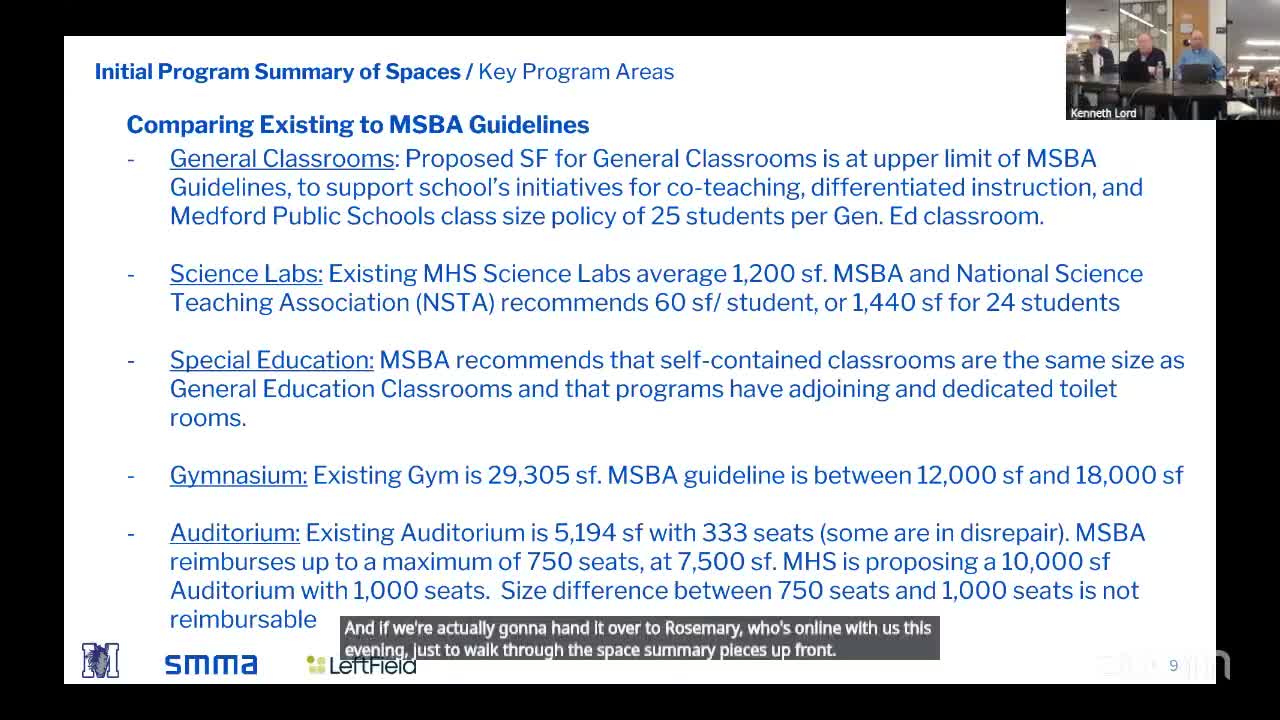
Summary
Consultants presented the PDP space summary showing large proposed net floor areas (classrooms at MSBA upper limits, a 10,000‑sqft auditorium and expanded CTE space). Committee members pressed for clarity on what portions MSBA will reimburse and expressed concern that building size drives municipal cost.
Consultants and district staff presented a detailed space summary for the Medford High School PDP and fielded questions about classroom sizing, CTE expansion and reimbursement from the Massachusetts School Building Authority.
Rosemary, presenting online, compared proposed net square footage with MSBA/DESE guidelines and described how the project derived gross floor area by applying a 1.5 grossing factor. She noted the team is proposing general classrooms at the MSBA upper guideline of 950 square feet and a proposed auditorium of 10,000 square feet with a seating capacity of 1,000; MSBA rules will reimburse up to 7,500 square feet for auditoriums. "They'll still participate in a building project that has an auditorium of 10,000 square feet," she said, explaining the project can propose larger spaces but reimbursement is subject to MSBA review.
Doctor DeLisi and district leaders defended larger classroom sizes as necessary for modern instructional models, describing co‑teaching, collaborative and project‑based learning and citing current collective bargaining class limits (25 in general classrooms; 24 in science). "We're no longer educating students by just sitting in rows," Doctor DeLisi said, urging that proposed sizes reflect current pedagogy and program goals.
Committee members pushed back on scale. "I'm deeply concerned about the size of the school," said committee member Luke Preisner, adding that size is "a direct proxy for cost." Members asked whether the initial pricing used the upper ends of guideline ranges for most categories and whether the MSBA reimbursement share of each proposed space could be estimated now. Consultants said MSBA reimbursement calculations depend on many factors — whether work is renovation or new construction, DESE review for Chapter 74 CTE programs, and incentive points — and cautioned against firm reimbursement percentages at the PDP stage. They recommended gathering MSBA feedback after the PDP submission and refining reimbursement projections during PSR.
The presentation also detailed program choices: the team is proposing expanded Chapter 74 CTE programs sized to DESE guidance and additional non‑Chapter 74 'hands‑on' instructional spaces (for engineering, family consumer science, etc.) to supplement curriculum. Resident Gaston Fury urged prioritizing vocational and technology programs and asked why vocational spaces appeared below DESE guidelines in one table; staff clarified that Chapter 74 program spaces are planned to DESE sizes and that the apparent shortfall related to non‑Chapter 74 supplemental spaces in the spreadsheet.
Consultants said benchmarking against other recent projects (Waltham, Somerville) can inform efficiencies but noted differences in program mix and enrollment make direct comparisons imperfect; staff said further benchmarking and life‑cycle cost analysis will be done as options narrow. The PDP is due to the MSBA on Feb. 25; staff said they will return with refined cost and reimbursement information after initial MSBA review and during the PSR phase.
The committee did not make final decisions about space sizing at the meeting; members were asked to review the narrative and spreadsheet materials before the scheduled Feb. 23 meeting to approve PDP submissions.