
Regional planning commissions press for flood-resilient roads, say towns need more grant support
Get AI-powered insights, summaries, and transcripts
Subscribe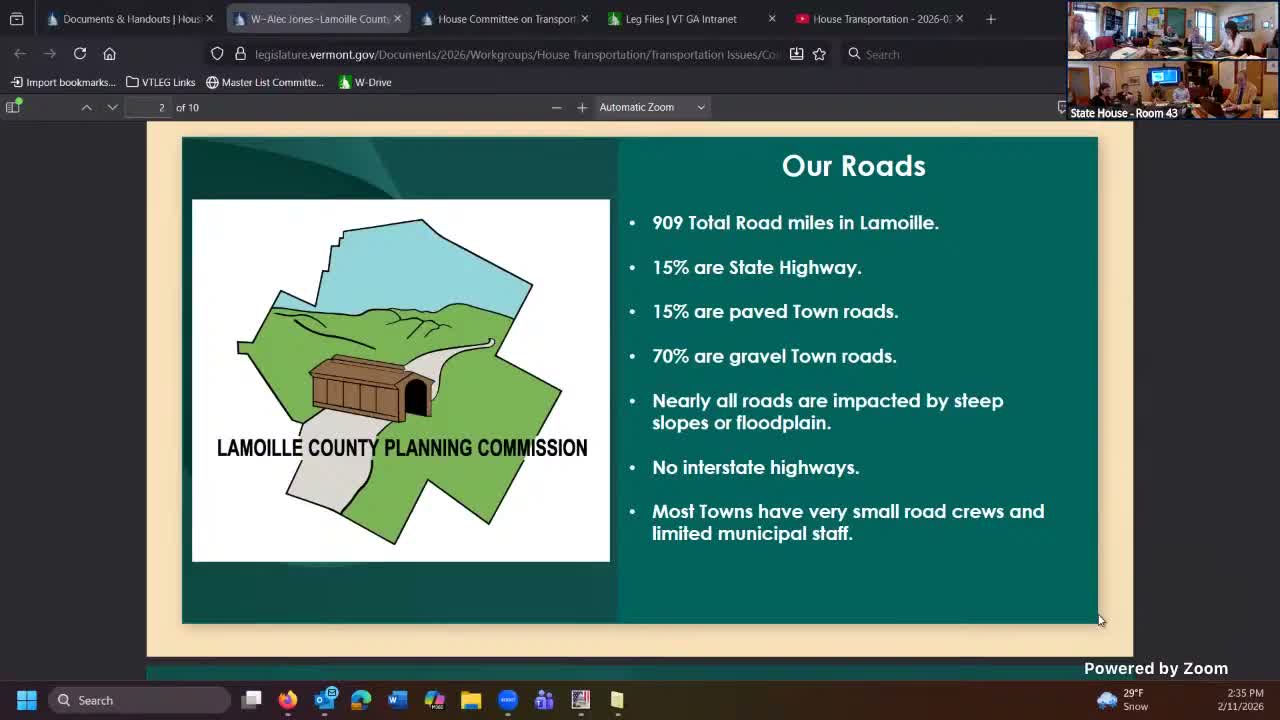
Summary
Regional planning commissions told the House Transportation Committee on Feb. 11 that rural road networks and flood-resiliency projects require continued technical assistance and easier access to grant funds; presenters highlighted a long hydraulic model and successful pilot projects but warned of municipal capacity limits.
House Transportation Committee — Regional planning commissioners told lawmakers on Feb. 11 that flood-resilient road design, coordinated grant planning and sustained technical assistance are essential for small towns recovering from repeated floods and for managing visitor-driven congestion in mountain corridors.
"We have just over 900 total road miles in [the region]," Alec Jones, transportation planner at the Memorial County Planning Commission, told the committee, adding that roughly 15% are state highways, another 15% are paved town roads and the rest are gravel. He said most towns have very small road crews and that steep slopes and flood plains affect nearly all local roads.
Why it matters: Presenters said repeated floods in 2023 and 2024 exposed vulnerabilities across rural networks and accelerated regional efforts to pair transportation planning with hydraulic and floodplain modeling. Seth Jensen, deputy director of the Memorial County Planning Commission, said the RPC extended a federally funded hydraulic model to cover headwaters through the mainstem and tributaries — calling it, in his words, "the longest publicly available hydraulic model East Of The Mississippi." That tool has been used with towns and VTrans to evaluate alternatives, select mitigation projects and reduce flood risk for vulnerable housing and village centers.
RPCs described a mix of technical work and on-the-ground projects: erosion inventories, culvert and bridge replacements, bus-stop and sidewalk inventories, and site visits to support grant applications. Presenters emphasized partnerships with conservation districts, state parks and VTrans ecology teams to design locally appropriate solutions. In Jeffersonville, after model-guided mitigation work following earlier floods, RPC staff said completed projects reduced flood levels in the village by about one and a half feet; modeling in Johnson suggested alternatives that could reduce flooding by about three feet.
Panelists also described transportation responses to tourism and congestion. Jones highlighted Smuggler's Notch corridor management — a plan begun in 1999 and completed in 2025 — and a pilot testing chicanes at either end of the notch to reduce truck "stuck" incidents and manage visitor parking. He said the pilot has been mostly successful but presents behavior and safety challenges when drivers bypass traffic controls through parking lots.
Funding and capacity remain central concerns. Multiple presenters described helping towns prepare grant applications but stressed that RPCs do not choose state-funded projects; they advocate and write applications on behalf of towns. Jason Rasmussen, executive director of the Mount Niskany Regional Commission, said RPCs collectively worked with more than 200 towns last year and that small regions still struggle to meet the workload required by some state grant programs. He urged streamlining and flexible approaches so more small communities can access better-connections, safety and multimodal funding.
The session also flagged transit and microtransit pilots, which presenters described as promising but potentially fragile if short-term funding lapses. RPC representatives cited two microtransit pilots — one running several years in Windsor and another launched in Springfield in November — and noted early positive feedback alongside concerns about long-term funding and driver availability.
What comes next: Committee members asked about local speed-limit changes, grant selection and how to tie multimodal roadway guidance to town plans. Presenters recommended clearer, local-facing guidance and more resources for towns to update plans, apply for grants and coordinate with VTrans. The committee closed the panel with thanks and said it would continue communications with RPCs about implementation and policy questions.