Seattle Office of Housing briefs council committee on funding pressures and housing‑cost disparities
Loading...
Summary
Office of Housing staff told the Housing, Arts and Civil Rights Committee that recent NOFA awards and short‑term stabilization funding helped projects, but long‑term operating funding risks — including a possible 40% cut to federal Continuum of Care funds — could create an estimated $19 million shortfall for Seattle and increase pressure on local levy and payroll‑expense resources.
The Seattle Office of Housing outlined on Feb. 14 the city’s priorities for 2026 and warned committee members of mounting operating and funding risks that threaten the stability of locally funded affordable and supportive housing.
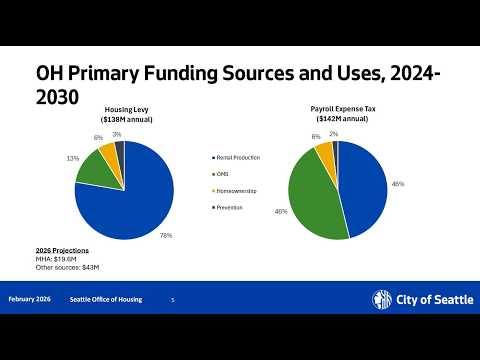
Kelly Larson, director of policy and planning, and Rosie Jo, director of capital investments, told the Housing, Arts and Civil Rights Committee that the office’s 2025 Notice of Funding Availability (NOFA) awarded $155,000,000 to support more than 2,000 apartments and that the majority of levy and payroll‑expense‑tax funds are dedicated to production and preservation.
"The office strives to achieve this vision by investing in community partners to create affordable housing," Larson said, summarizing the office’s work to build and preserve homes while funding services that keep supportive housing operating.
Larson and Rosie Jo said the office has used short‑term stabilization tools — $14 million in 2024 and $28 million in 2025 — to provide rent assistance, support staffing and cover capital needs while OH updates underwriting and conducts portfolio reviews. The presenters emphasized the difference between capital funding for construction and the ongoing operating, maintenance and services (OMS) costs that supportive housing requires.
"Supportive housing requires deeper and longer‑term subsidies to pay for operating and services costs," Larson said, noting that OMS spending has shifted toward local funding streams as federal and county contributions have declined.
The presentation flagged a potential federal funding shock: OH modeled a scenario in which a 40% reduction in federal Continuum of Care (CoC) funds in 2027 would translate to an approximately $19,000,000 gap for Seattle projects, with the potential for larger shortfalls depending on future HUD decisions.
"These obligations for OMS will continue every year as long as these buildings are operating," Larson said, arguing the city must plan for both short‑term stabilization and longer‑term structural responses.
Council members focused questions on timing and options. Council member Rink asked when committee members could expect the $6 million rental assistance proviso to be distributed; OH said it plans to move the funds as quickly as possible after completing partner allocations. Foster and other members pressed OH to make clear how payroll‑expense‑tax (PET) dollars and the housing levy will be used, with Foster noting that roughly $40,000,000 a year in PET may be needed to meet current levy goals.
Larson also addressed public reporting on vacancy rates, telling the committee that OH’s portfolio annual vacancy rate is roughly 6–7 percent (median about 4.7%), and that different measures (point‑in‑time versus annual) can produce diverging figures.
The presentation included data on incomes and racial disparities: OH said AMI used for rent setting has risen about 64% in eight years and noted that Black and Indigenous households are more likely to have incomes below 50% of AMI. The office emphasized that the greatest need is at the lowest income levels (0–30% AMI) and described plans to prioritize preservation and supportive housing operating funds.
Larson closed by saying OH will return with more detailed reports and dashboards, including an updated Seattle Housing Investment Plan and additional information about how stabilization dollars were deployed.
The committee thanked staff and moved on to a separate presentation from the Seattle Social Housing Developer.
The committee did not take a formal vote on additional OH proposals at this meeting; presenters promised follow‑up reports and timing information for the rental assistance proviso.