
Sumner County ad hoc committee hears CTAS plan to shore up volunteer fire services
Get AI-powered insights, summaries, and transcripts
Subscribe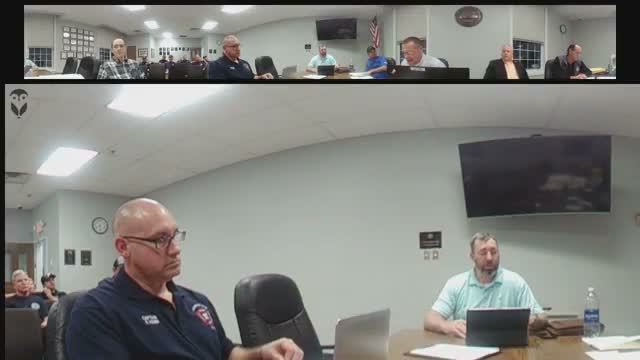
Summary
CTAS consultant Mark Alley told a Sumner County volunteer fire department ad hoc committee on Feb. 10 that the county faces persistent staffing and funding shortfalls and presented four paths forward—stay nonprofit, create a county fire marshal, use county contracts, or form a county fire department—while urging the group to collect baseline data for budgeting.
Mark Alley of the County Technical Assistance Service told Sumner County’s volunteer fire department ad hoc committee on Feb. 10 that Tennessee’s volunteer fire system faces a long-term staffing and funding squeeze and that counties must plan now to avoid a crisis.
Alley, the meeting’s primary presenter, said Tennessee spends “well over 1000000000 dollars” across local and grant funding for firefighting but nonetheless lacks consistent standards and personnel levels in many jurisdictions. “Tennessee is ... the fire service is not an essential service in the state of Tennessee,” Alley said, arguing that the state’s statutory and operational framework leaves volunteer departments financially and administratively vulnerable.
The presentation framed four broad options for Sumner County: remain nonprofit and continue relying on donations and grants; create a county fire marshal to coordinate and support nonprofit departments; establish a county fire department that contracts with existing stations; or — as a larger step — form a fully paid county fire department. Alley described key trade-offs: nonprofits preserve local control but face uncertain revenues and administrative burdens; a county fire marshal can centralize grant writing, reporting and training without assuming command authority on scenes; contracting can standardize equipment and enable automatic aid; and a paid county force would require substantial new ongoing county funding.
Alley used examples from other Tennessee counties to illustrate the choices. He said some counties that moved toward county control received state grants to build stations but still required a detailed plan to spend the funds and sustain operations. On contracting and ISO insurance ratings, Alley said combining multiple stations into a single graded department can satisfy ISO staffing metrics if the combined entity is graded as one department.
Committee members pressed Alley on details. When asked whether a county fire marshal must perform building plan review, Alley replied, “You can write the job description any way you want to.” On whether contracting departments could count toward ISO first-alarm staffing, Alley said combining stations as a single department can meet the four-person threshold.
Alley warned that many volunteer departments cannot reliably provide four personnel for a first-alarm structure and cited a random sample where roughly 43% of departments could not muster that number. He also flagged administrative burdens for multiple nonprofits — duplicated NEARS/reporting and audit requirements — and suggested a county-level administrative position could reduce duplicated work and make grant application and compliance more consistent.
The committee also discussed local funding tools: fire tax districts, reallocating building-permit fee revenue, donations of capital equipment, or county bond financing for major purchases. Alley cautioned that some funding approaches — for example, designating all permit fees for fire donations — can merely reallocate existing dollars rather than increase overall funding and that state law limits how counties can transfer funds to nonprofits (monetary donations only under current statute). He also recommended updating any outdated boundary resolutions so county maps and the fire marshal’s records align.
The committee requested baseline data from all nonprofit departments and their boards so staff can produce budgetary estimates and next-step recommendations. Chair Speaker 1 asked Chiefs to collaborate with Chief Edgerton to gather the requested information.
Procedural notes: the committee approved the meeting agenda by voice vote and approved minutes from the Jan. 13 meeting (voice vote; four ayes and one abstention recorded for the minutes). The meeting adjourned after the presentation and Q&A.
Next steps: committee staff will collect the baseline reports and financial information needed to compare options and prepare budgetary recommendations for future meetings.
Quote-attributions are taken from the meeting transcript and limited to speakers on the record: Mark Alley and committee participants.