
Committee reviews draft Vermont Homelessness Response Continuum; debate over multi‑year agreements, payment rates and hotel use
Get AI-powered insights, summaries, and transcripts
Sign Up Free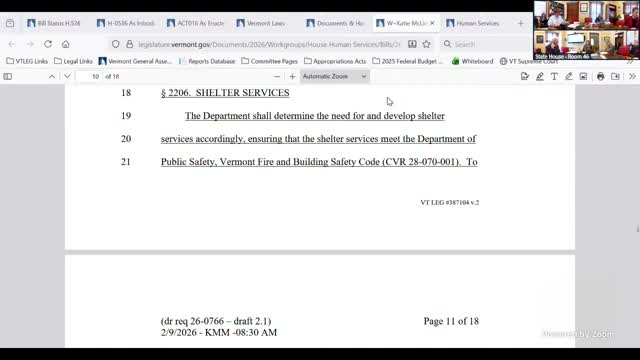
Summary
At a Feb. 11 markup on a committee bill to create a Vermont Homelessness Response Continuum (committee bill “766”), lawmakers and service providers debated a new two‑year minimum agreement for shelter contracts, whether rates must fully cover operating costs, and rules for using hotels and motels while permanent housing is developed. The committee asked staff to draft collaborative base‑rate language, clarify agency roles, and return with memos and suggested statutory text.
A legislative committee convened Feb. 11 to resume markup of a draft bill creating a Vermont Homelessness Response Continuum (committee bill, “766”), focusing on shelter services, specialized shelter services and emergency hotel and motel usage.
Katie McLennan of the Office of Legislative Council said the draft (2.1) places the Department responsible for determining shelter need and entering agreements with community partners to provide shelter services that meet Department of Public Safety, Vermont Fire and Building Code safety rules. The draft includes a new minimum two‑year agreement term for providers. Committee members questioned whether two‑year agreements are feasible within the state’s grant and appropriation processes and whether statutory language should direct the Department to use agreements rather than contracts.
Service providers and advocates supported multiyear terms to add stability. One provider said multiyear agreements reduce annual uncertainty and administrative burden for nonprofits. Stakeholders also urged that payment rates not leave providers financed short of operating costs if the state places households in shelters: "If the state is placing people in a shelter, they should pay the cost of operating the shelter," a provider told the committee. Several participants said the draft should ensure rates cover operating costs rather than shifting the burden onto community partners.
Committee discussion centered on who should set rates. Staff and some members recommended leaving specific dollar amounts out of statute and instead requiring the Department to collaborate with community partners (including DCF) to establish a base rate and supplements for specialized services (for populations with substance‑use, mental‑health or other healthcare needs). Sean Hurdle told the committee his organization had submitted a memo and flagged more detailed payment‑rate language later in the draft.
On hotels and motels, the draft expresses an intent to decrease reliance on such emergency housing as permanent shelter capacity increases. The committee removed a cross‑reference that had limited hotel/motel use to winter months, after members said that limitation appeared unintended. The bill does not set a numerical cap on rooms; instead, members said the appropriation process will create dollar limits for funding “buckets,” and the department would need to budget within those amounts. Members and providers debated whether block agreements (prebooked blocks of rooms) or per‑night bookings are more efficient; examples from past emergencies showed blocks can secure lower rates but risk paying for unused rooms.
Committee members raised operational concerns about service coordination across multiple community providers, and whether a lead case‑management entity should be designated to ensure continuity and reduce overlap. The draft references assigning each eligible household a lead case‑management entity; participants discussed whether households should be allowed to choose or change their case manager when required services are attached to housing placements.
Members also discussed a needs assessment to identify regional service gaps and promote equity. Options included contracting with DCF to commission an ongoing assessment (every 3–5 years), using existing continuum‑of‑care assessments, or commissioning an independent study. The committee asked staff to draft placeholder language requiring stakeholder collaboration on rates, to circulate memos from providers, and to return with suggested statutory text on specialized services, agency consultation, and a needs assessment.
The committee did not take formal votes during this session. Members paused the markup before Section 2209, requested memos and suggested statutory language from stakeholders and staff, and scheduled further work on permanent supportive housing definitions and diversion strategies.