Lifetime Citizen Portal Access — AI Briefings, Alerts & Unlimited Follows
Senate Art Committee narrows guidance for Freeman and Adams busts; requests maquettes and historian input
Loading...
Summary
The Senate Art Committee instructed four shortlisted artists to submit second‑round maquettes (clay or comparable medium), emphasized strong, direct expressions and simplified clothing for busts of Elizabeth Freeman and Abigail Adams, and agreed to consult costume and African American historians before finalizing directions.
The Senate Art Committee on Monday finalized guidance for second‑round proposals from four shortlisted artists to create portrait busts of Elizabeth Freeman and Abigail Adams, asking for clay maquettes (or equivalent studies), clearer guidance on clothing and headwear, and additional historian consultation before artists receive the full brief.
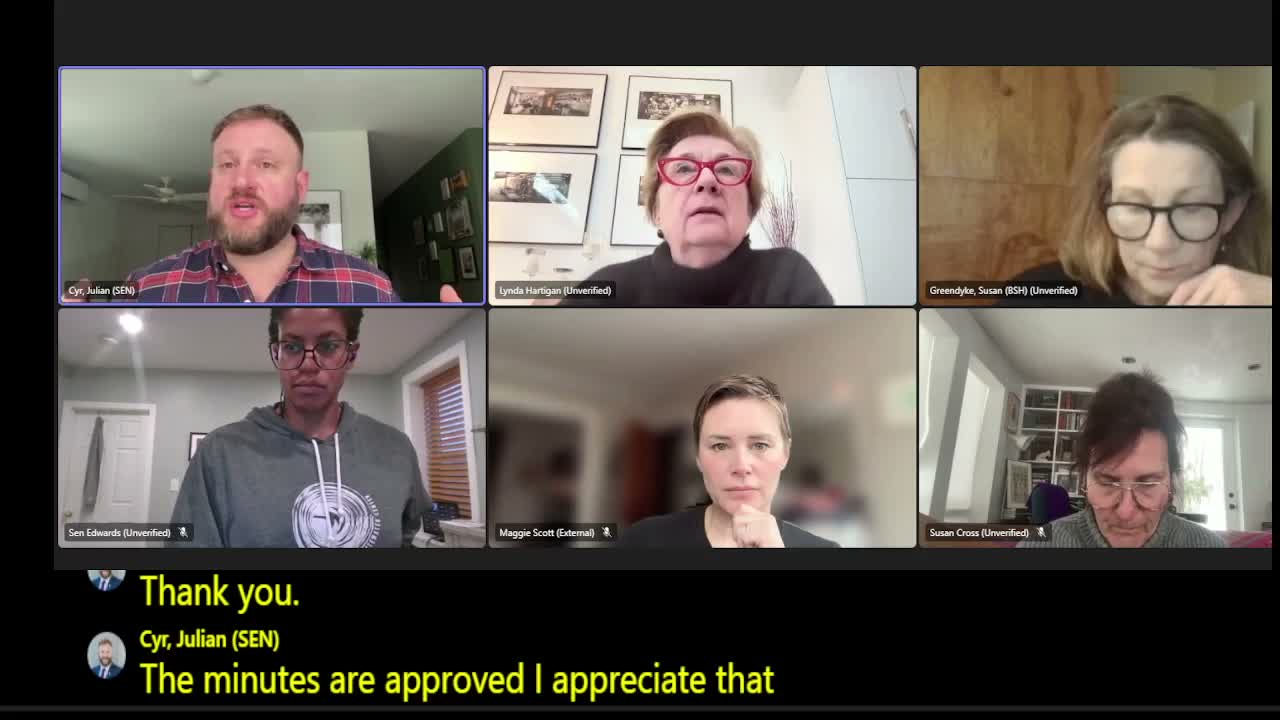
The Committee Chair opened the virtual meeting by summarizing the group’s objective: ‘‘we want greater clarity and expression, gaze, and presence’’ so the finished works ‘‘will read clearly and powerfully in the senate chamber.’’ The committee moved to accept minutes from an earlier meeting (motion by Linda Hartigan; second by Maggie Scott), and approved the minutes before turning to design and historical questions.
Tina Norton, introduced as a retired museum professional and historian, told the committee that the governing principle for both sitters should be character and presence. Norton quoted historian Bernard Bailyn on Abigail Adams, saying her face ‘‘expresses . . . the maturity and the power of personality’’ and urged artists to prioritize personality over ornament. Norton recommended portraying both women around age 40, noting 1783 (the period after Massachusetts moved against slavery) as an appropriate visual context so the figures appear contemporaneous and authoritative.
On clothing and headwear, the committee discussed striking a balance between historical accuracy and visual clarity. Norton said roughly half the period portraits she studied showed caps and that caps could signal modesty and social status; she recommended simplified caps if used. Several members, including Linda Hartigan and Susan Cross, worried that oversized bonnets or ornate accessories could ‘‘wear the figure’’ and agreed clothing should remain secondary to facial expression and presence. Maggie Scott raised concerns that historical ‘‘tignon’’ or sumptuary laws in the U.S. South had required head coverings for Black women and asked whether depicting Elizabeth Freeman in a bonnet might carry problematic connotations; Norton said she did not know that history in detail and the committee agreed to obtain additional cultural‑historical guidance before issuing final directions.
Committee members also reviewed how the new busts will sit visually with existing chamber sculpture. Discussion noted that many current busts use classical drapery while a few—such as a more recent Frederick Douglass work—include visible contemporary garments. The group concluded the two new busts should feel visually coherent with each other and the chamber overall, with expression and direct outward gaze preferred and portrayals that avoid appearing fearful, overly stern, or sorrowful.
On process, the committee proposed asking shortlisted artists to submit maquettes in clay, plasticine or polymer to ensure an apples‑to‑apples comparison. The committee set reimbursement at up to $2,000 per artist (with members suggesting a midrange of $1,500–$2,000), suggested a target turnaround of about six weeks (with flexibility up to eight on request), and proposed a one‑third scale limit for studies. The staff noted the original request for proposals allowed the committee to request additional materials and extend timelines; members agreed the committee could ask artists to make studies for one or both sitters but discussed fairness and potential hardship case‑by‑case exemptions.
Next steps: the committee will consult additional experts—a costume historian (Museum of Fine Arts collection staff was suggested) and specialists in African American portraiture—before finalizing the second‑round instructions. The group scheduled a follow‑up meeting for Monday, Feb. 9 to review refined guidance and then notify the shortlisted artists.
The meeting closed with the Chair thanking Norton and staff; the committee adjourned with instructions to circulate the revised brief and expert contacts. The minutes approval and the plan to request maquettes were recorded as the meeting’s formal outcomes.