
Los Angeles General presents 'Safer at Home' program to HCAI board, cites shorter stays and net savings for safety‑net patients
Get AI-powered insights, summaries, and transcripts
Subscribe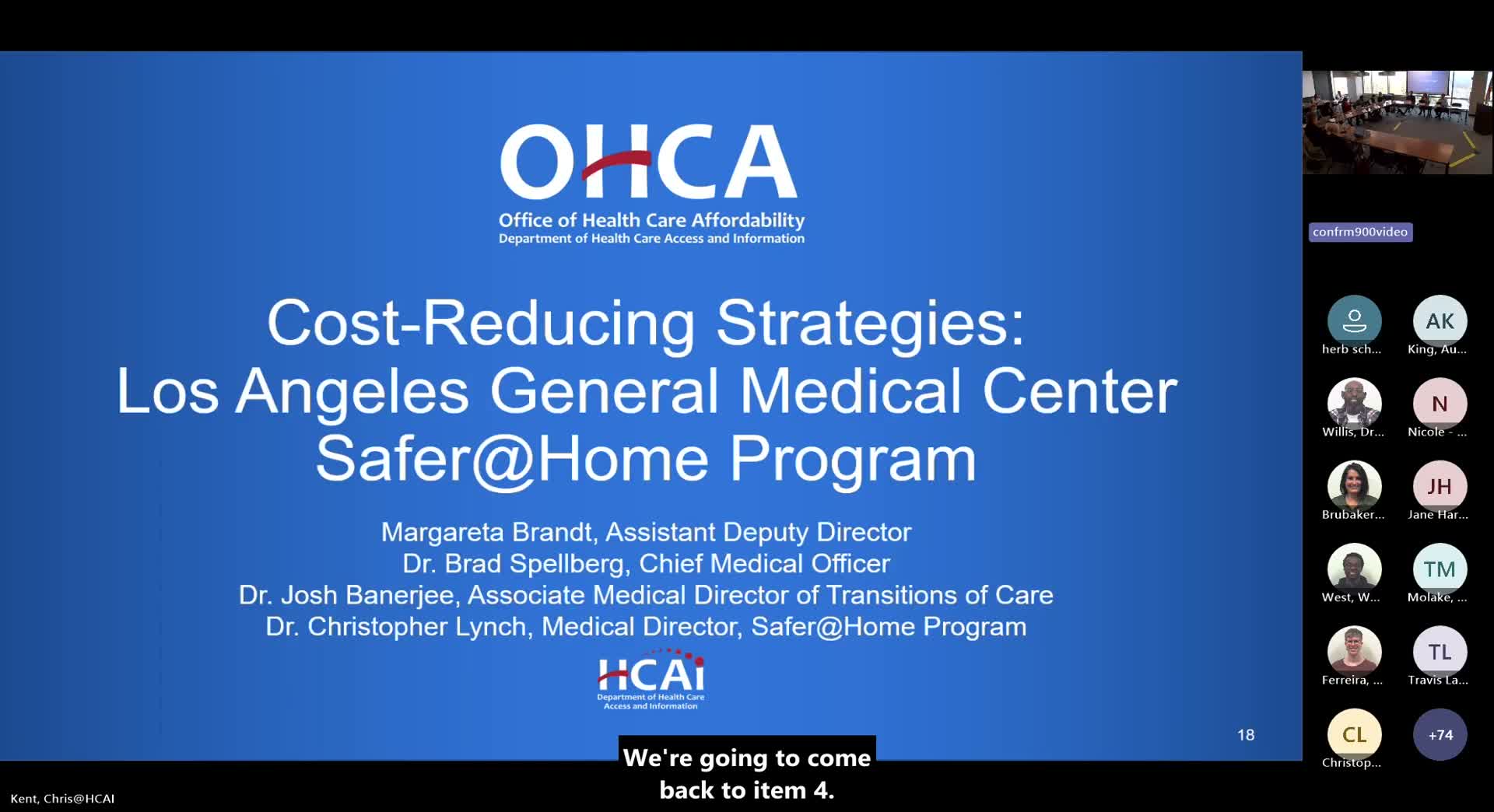
Summary
Los Angeles General Medical Center presented its Safer at Home virtual acute‑care program to the Department of Health Care Access and Information board, reporting shorter hospital stays, no reported deaths at home in its COVID-era cohort, and a first‑year net savings of about $6 million for a largely Medicaid/uninsured population. OCA staff noted it did not independently verify the hospital's data.
Los Angeles General Medical Center told the Department of Health Care Access and Information advisory board that its Safer at Home program, a nursing‑led virtual alternative to inpatient care, reduced hospital length of stay and produced net savings while maintaining similar short‑term clinical outcomes.
Dr. Brad Spellberg, chief medical officer at Los Angeles General, said the program began in March 2020 to safely manage patients with COVID pneumonia at home when the hospital faced severe capacity constraints. “We cared for more than 4,000 COVID pneumonia patients over a three‑year period using this program, and not 1 died at home. 0,” Spellberg said during the presentation. The team said the program was later expanded beyond COVID to include heart failure, selected infections, high‑dose oral steroid regimens for neurologic flares and other diagnoses.
The presenters cited peer‑reviewed analyses published in JAMA Network Open that measured Safer at Home outcomes for the program’s early cohort. In the first 12 months the hospital reported 876 enrolled patients matched to 1,590 controls; Safer at Home patients had an average of about four fewer inpatient days than matched controls, fewer 30‑day emergency‑department revisits, and no statistically significant change in 30‑ or 90‑day mortality or readmissions, according to the materials presented.
Financials and payer mix: presenters said Safer at Home serves a safety‑net population (reported payer mix: 77% Medicaid, 7% uninsured, ~85% Medicaid/uninsured combined). The team reported a first‑year net savings of roughly $6 million after accounting for an estimated $4 million in foregone inpatient revenue, $10 million in avoided inpatient variable costs and approximately $700,000 in additional fixed costs (two FTE nurses, half FTE hospitalist, DME). Presenters also showed modeling suggesting an ongoing reimbursement level of roughly 50–55% of a Medicare DRG could make the program financially viable for hospitals with different payer mixes.
How it works: staff said patients must meet clinical criteria (improving trajectory, low probability of rapid decompensation, ability to self‑monitor or have an existing caregiver), receive disease‑specific DME (pulse oximeter, thermometer, scales for heart failure), and have daily nurse phone/video check‑ins supervised by hospitalists. The program uses teach‑back education, multilingual materials and an UberMed transport contract to return patients to the hospital for in‑person evaluation if needed.
Board and public reaction: board members and public commenters largely praised the clinical intent and results while pressing for clarity about safeguards and equity. Several asked how the model could be scaled beyond a safety‑net payer mix and how to secure payer reimbursement. The California Nurses Association urged caution about shifting skilled nursing work to unpaid family caregivers and asked OCA and the hospital to assess workforce impacts; Health Access California recommended making the patient‑and‑caregiver eligibility and teach‑back criteria explicit in future materials.
OCA staff noted that the office did not independently verify the presenters’ results and is sharing Safer at Home as an example of a cost‑reducing strategy other entities may evaluate. Board members asked staff to follow up with supplementary materials on caregiver safeguards and operational criteria.
The board took no formal action on the presentation; the item was informational and followed by public comment and Q&A.