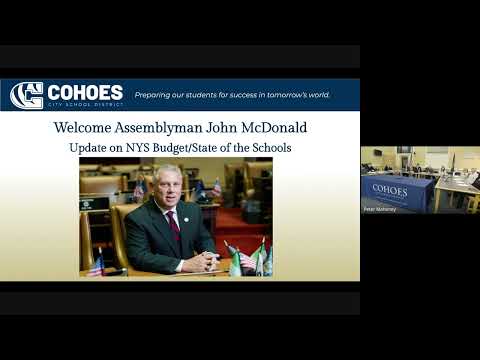
Assembly Member John McDonald outlines state budget outlook and UPK changes during Cohoes school board meeting
Loading...
Summary
Assembly Member John McDonald briefed the Cohoes City School District Board on the governor's proposed budget, noting a 1% foundation‑aid increase for many districts, potential UPK per‑seat increases that could raise funding for Cohoes, and a proposal to extend services for 21‑year‑olds to age 22; board members pressed for clarity on high‑cost special‑education reimbursements and mental‑health funding expiration.
Assembly Member John McDonald told the Cohoes City School District Board of Education on Jan. 28 that the governor's proposed budget includes modest increases in education aid but important unknowns that could affect the district's bottom line.
"Foundation aid is up 1%" McDonald said, adding that while that increase is welcome, it does not keep pace with rising expenses such as health care and special‑education costs. He described broader state budget context—improved reserves and revenue projections—but warned of federal funding uncertainty and across‑the‑board pressures on districts.
McDonald highlighted potential changes to universal prekindergarten (UPK) funding, noting state discussions that could raise per‑seat payments for some districts. Using rounded examples during the meeting, he said where a seat previously received about $4,500 the state discussion contemplates rates closer to $10,000 in some cases, producing a potential “catch‑up” payment on the order of several hundred thousand dollars for a district like Cohoes if final rules reflect those figures. He cautioned, however, that the details and restrictions were not yet finalized.
Board members pressed McDonald and district staff on how the state counts high‑cost special‑education and private‑placement reimbursements. District representatives said private‑placement costs can run into high five digits or more—one speaker referenced figures around $100,000 for some placements—and that current reimbursement formulas and age cutoffs (historically 6–21) leave unresolved cost burdens for districts. McDonald said proposed FRAP changes to extend eligibility from 21 to 22 could help some students with significant disabilities but noted districts are still seeking clarity on reimbursement mechanics.
Members also raised concerns about pandemic‑era mental‑health supports funded through stimulus grants that are scheduled to expire. McDonald urged coordination with local nonprofit providers and state advocates, saying the administration has increased mental‑health line items but that sustained local arrangements will be necessary.
McDonald urged districts to track detailed expense data and testified that the legislative process will continue at budget hearings; he encouraged school officials to remain engaged as the details—particularly program rules and allowable uses—are finalized.
The board did not take action on any budget items at the meeting; McDonald’s remarks were provided for local planning and advocacy ahead of forthcoming state hearings.