Get Full Government Meeting Transcripts, Videos, & Alerts Forever!
Get email alerts on the Student Outcomes topic
No spam. Unsubscribe anytime.
Arkansas falls short of ESSA long-term goals; Atlas shows modest gains but wide subgroup gaps
Summary
Presenters told lawmakers Arkansas did not meet ESSA long-term achievement goals in 2025: Atlas results show 35% ELA proficiency, 39% math, and persistent gaps for English learners and students with disabilities; graduation-rate goals remain unmet.
Bureau analysts told the Joint Education Committee that Arkansas has not met the long-term ESSA proficiency goals the state set for 2030 and that Atlas assessment results for 2025 show modest year-over-year increases but large subgroup disparities.
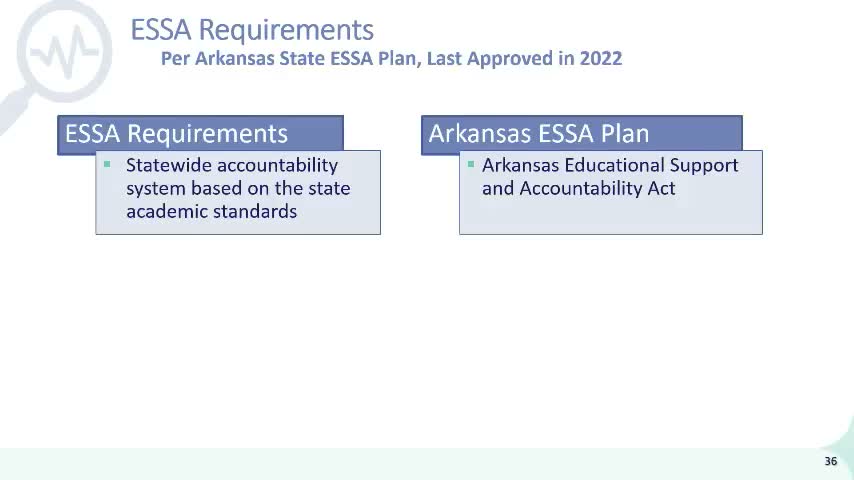
Adrienne Beck reviewed ESSA's long-term goals adopted in Arkansas's state plan and the state's checkpoint targets to 2030. "The first achievement goal is to have 80 percent of students achieving a test-based grade-level proficiency score in ELA and math," Beck said, noting that no student group met that threshold in 2025.
Using Atlas results, staff reported that 35 percent of students scored proficient or above in English language arts, 39 percent in math and 38 percent in science for the 2025 school year. Those were increases from the prior year but remain far below the 80 percent goal. Staff also summarized subgroup performance: English learners had the lowest rates (as low as 5 percent proficient in some ELA grade-level slices and up to 11 percent in math), while white students had the highest subgroup percentages (42–48 percent depending on subject).
Beck explained the state's "on track" metric for English learners under ESSA (exit status, ELPA21 domain progress or meeting time expectations on ELPA21 domains) and said historical on-track percentages fell from a 2018 baseline and have not yet recovered to the initial checkpoint levels. She also reviewed graduation-rate goals (94 percent 4-year and 97 percent 5-year by 2030) and reported Arkansas's most recent 4-year graduation rate at 89 percent and 5-year rate at 90.2 percent.
Committee members asked for historical highs and lows, whether pandemic-era disruptions explain declines, and for cross-state comparisons; staff said older assessments are not strictly comparable but agreed to provide historical high/low charts for members to review with notation about comparability when different assessments were used.
The presentation noted that some assessment components (K-2 interim and K-3 screener public results) for 2024–25 had not yet been released publicly and that the ESSA school index was not calculated for 2024–25, limiting some trend comparisons. Staff pledged to supply requested historical comparisons and to follow up about the missing public reporting items with DESE.