Get Full Government Meeting Transcripts, Videos, & Alerts Forever!
Get email alerts on the Surveillance Policy topic
No spam. Unsubscribe anytime.
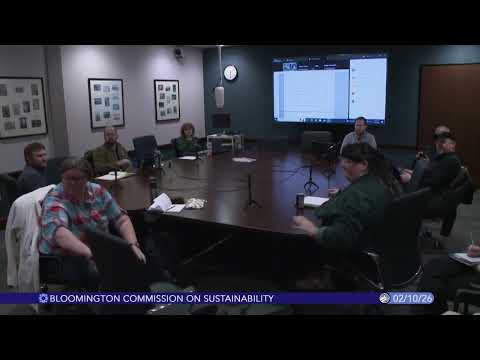
Bloomington sustainability commission advances surveillance resolution after public petition
Summary
The Bloomington Commission on Sustainability advanced Resolution 2026-02 — addressing automated license-plate readers and related surveillance technology — to a second reading after public comment and extended debate about contracts, transparency and alternatives.
The Bloomington Commission on Sustainability voted to advance Resolution 2026-02, a detailed proposal addressing automated license-plate readers and other mass-surveillance technologies, to a second reading after public comment and extended discussion on procurement, transparency and alternatives.
A Zoom speaker identified in the meeting UI as Cale told commissioners a petition signed by roughly 155 Bloomington and Monroe County residents asked the commission to support the resolution, to “disable all currently deployed black cameras in Bloomington” and to recommend against renewing contracts for that technology. The petition and signatory list were submitted for inclusion in the public record, the commenter said.
Commissioners debated next steps rather than taking a final vote. Discussion touched on contract value and ownership models — the chair said an earlier security-trailer contract was for $50,000 and commissioners said many deployed cameras appear to be leased rather than city-owned — and on whether any city funds redirected away from cameras could be reallocated to community resilience programs instead of replaced by a different vendor. One commissioner urged adding language to the resolution to recommend not replacing terminated contracts with equivalent surveillance technology.
The resolution’s text as presented cites social-science research on the community impacts of pervasive surveillance and frames the item under social sustainability and community resilience. Commissioners also discussed possible transparency measures — including whether camera locations and access logs could be subject to public-record requests — and noted that some audit logs from other jurisdictions are publicly available.
Commissioners praised the resolution’s framing and asked to collect suggested line-number edits for a consolidated amendment process before the next meeting. The commission voted to advance Resolution 2026-02 to a second reading (roll call recorded in the meeting) and agreed to continue drafting specific amendment language, including a proposed clause that would discourage replacing ended contracts with functionally identical systems.
Next steps: commission staff will collect member edits (by line number) for consolidation ahead of the second reading, and members discussed inviting outside experts or community researchers to provide additional evidence at the next meeting.
"We can't have sustainability without social justice," one commissioner said during discussion, urging the commission to treat surveillance impacts as part of its broader mission.
The second reading and any amendments will appear on the commission’s next agenda; public comment will be accepted under the usual rules at that meeting.