Get Full Government Meeting Transcripts, Videos, & Alerts Forever!
Get email alerts on the Donaldson Scholars Audit topic
No spam. Unsubscribe anytime.
Audit finds scholarship eligibility and accounting problems at Donaldson Scholars Academy; committee tables review
Summary
A legislative audit of the Charles W. Donaldson Scholars Academy at UA Little Rock found misclassified expenditures, scholarship awards to ineligible students, and widespread disbursement exceptions; the Legislative Joint Audit Committee voted to table the report for further review and follow-up.
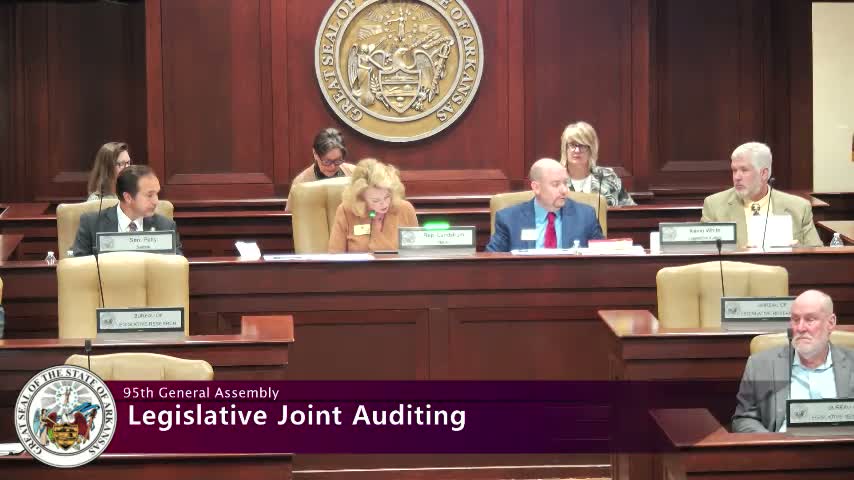
A legislative audit presented to the Legislative Joint Audit Committee found irregularities in scholarships and spending at the Charles W. Donaldson Scholars Academy, a program funded with $10 million in Pulaski County desegregation funds and administered through the University of Arkansas at Little Rock (UALR).
The audit reported the program awarded $1,870,000 in scholarships to 379 students and that 116 of those students graduated from college. The audit found scholarship records in student files did not always match expenditures recorded in the general ledger, citing misclassification of expenditures and eligibility exceptions identified during testing. The auditors tested 10% of participating students and found exceptions for 32 of the 39 students examined; of $350,000 in awards tested nearly 32% went to students judged ineligible under the program rules.
Auditors also tested 147 disbursements totaling about $1,900,000 and reported 124 exceptions, which included lack of proper authorization, missing documentation and clerical inaccuracies. The report noted two capital assets with an unknown disposition after the program closed. The audit documented a $50,000 grant used to fund student and faculty travel to Spain and Morocco in 2015; trip costs identified in the record totaled more than $89,000 and were reported as allowable under that external grant.
"This is just an embarrassment and a total waste of money," Representative Beatty said during committee discussion after the audit presentation, objecting to what he described as limited scholarship dollars reaching students while other funds paid for travel and events.
UALR officials at the table said the program began in 2014 by order of a federal court overseeing a desegregation case and wound down in 2024. Charles Lightford, associate general counsel for UALR, described the program as having been treated as a sponsored program with external funding approved by the federal court and subject to oversight by sponsored-program offices and the intervenors who filed status reports with the court. Alan Stanley, vice chancellor for finance and administration at UALR, said the university returned about $1.6 million in unspent funds to the Pulaski County Special School District when the program wound down.
Committee members pressed university witnesses for names of program staff no longer employed, institutional breakdowns of spending among the three participating schools (UALR, Philander Smith College and Pulaski Technical College), and whether the report should be referred to prosecuting authorities. Representative Dalby formally asked whether the report had been turned over to the attorney general or federal prosecutors; staff said referral to prosecutorial authorities could be suggested by the committee.
After extended questioning and requests for additional documentation, Representative Burks moved to table the Donaldson Scholars Academy report so members could review the material and gather answers to outstanding questions; the motion was seconded and approved by voice vote.
The Legislative Joint Audit Committee asked staff to obtain additional details, including the court’s order(s) that established program requirements, an institution-by-institution accounting of expenditures, and responses from Philander Smith College and Pulaski Technical College (staff noted those institutions had not provided full responses at the hearing). The committee also asked that faculty who helped design the program be invited to return for questioning.
The audit and the committee discussion leave open key questions about how scholarship eligibility was determined, why expenditures were classified as they were in the general ledger, and whether the spending comported with the federal-court order that originally approved the program. The committee will revisit the report at its next meeting after staff follow-up and additional documentation are provided.