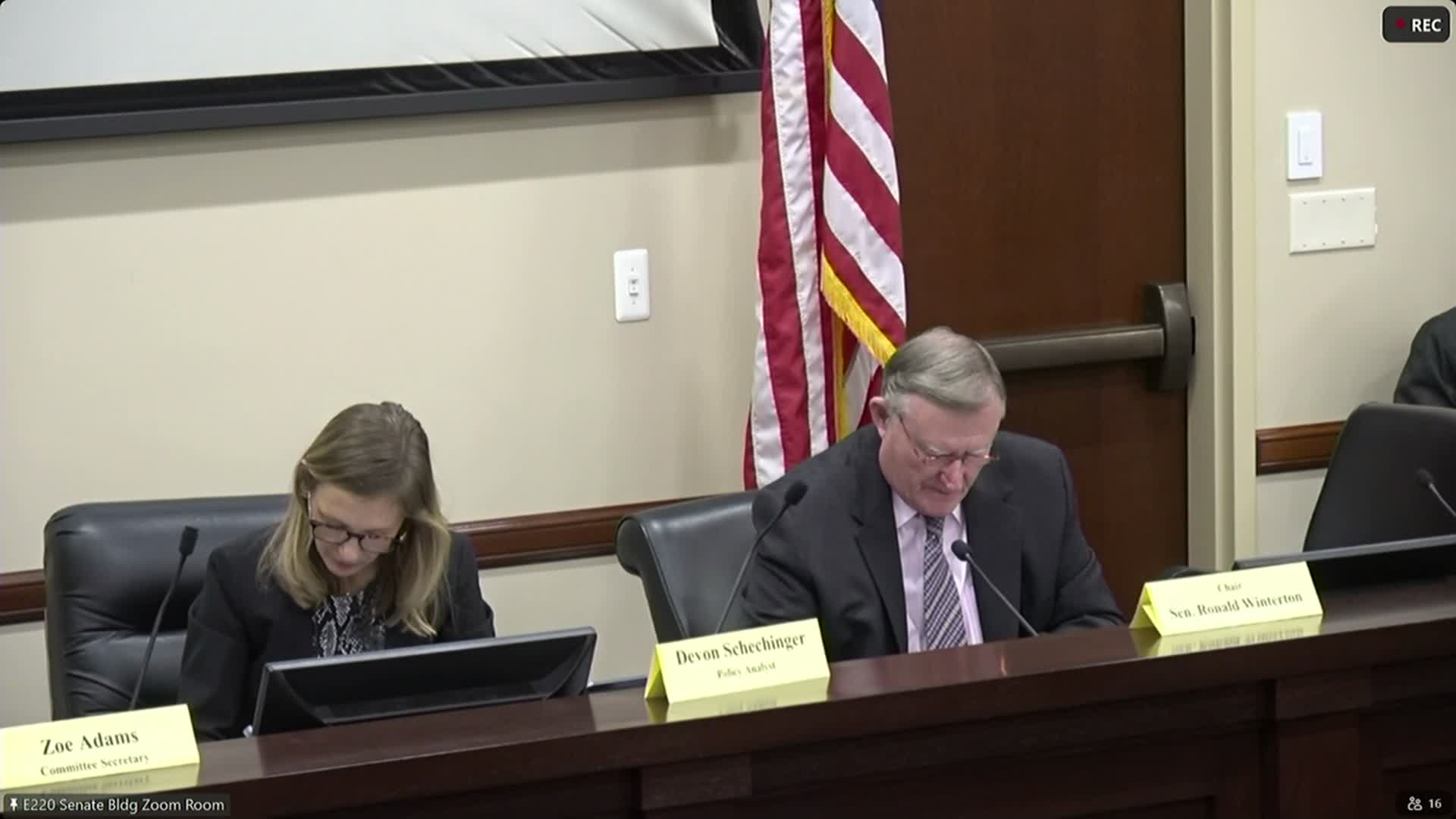
Senate committee holds county governance bill after officials raise concerns about manager/council powers
Loading...
Summary
Senate Bill 266, intended to clarify lines between elected county officials and unelected county managers, was held in committee after testimony from county clerks, managers and elected officials who flagged drafting inconsistencies and potential conflicts with voter‑approved forms of government.
The Senate Government Operations and Political Subdivisions Committee on Thursday voted to hold Senate Bill 266, a draft intended to clarify the distribution of executive and legislative powers in county governments, after a series of public witnesses raised drafting questions and potential conflicts with voter‑adopted county governance forms.
Sponsor summary and intent Senator Winterton introduced SB266 as an attempt to define ‘‘gray areas’’ in county governance—particularly between county commissions and county councils—so that voters and officials understand whether a county operates under an elected executive or a manager‑council system. The sponsor said the bill is not intended to eliminate professional county managers but to establish clearer statutory lines about which functions unelected employees may not exercise without ordinance or explicit delegation.
Concerns from counties and elected officers Multiple county officials and representatives testified with mixed views. Jerry Houghton (Tooele County recorder/surveyor) and Kendall Thomas (Tooele County) said Tooele voters chose a manager‑council form and cautioned the Legislature against broad fixes for local issues. Roger Armstrong (Southern County Council) warned the bill as drafted might vest executive authority in part‑time council members, creating impractical workload and delegation conflicts; he identified internal inconsistencies where some sections prohibit delegation while others appear to allow it. Evelyn Furze (Summit County Clerk) said the bill appeared to restrict discussion of independent elected officials’ salaries and asked that duties not be unintentionally shifted from elected offices to the council because of prior code changes. A county association representative (identified in the transcript as Lincoln Shirts) urged alignment with enabling legislation so that voter choices granting manager duties are honored and offered to work with the sponsor on technical fixes. Mary Anne Christiansen (Utah Legislative Watch) supported clarifying statutory authority to ensure accountability to voters.
Sponsor response and committee action Senator Winterton acknowledged concerns, said the bill draft omitted clarifying language in places, and moved to hold the bill and prepare a substitute that incorporates the technical corrections and clarifications raised in testimony. Senator McHale and others expressed sympathy for both protecting elected accountability and preserving access to professional managers; several members supported holding the bill to refine policy. The committee voted to hold SB266 (committee reported '6 to 0').
Why it matters SB266 touches on the balance between elected accountability and professional administration in county government. Testimony emphasized that some counties adopted manager‑council forms by voter initiative and that any statutory changes should respect enabling instruments and avoid unintentionally stripping delegated duties. Several witnesses asked for precise statutory language to prevent litigation and preserve the will of local voters.
What’s next Sponsor plans to work with county officials and association counsel to produce a substitute draft that clarifies delegation, honors enabling legislation, and addresses drafting inconsistencies; the bill is held in committee pending those revisions.