Get Full Government Meeting Transcripts, Videos, & Alerts Forever!
Get email alerts on the Elections And Terms topic
No spam. Unsubscribe anytime.
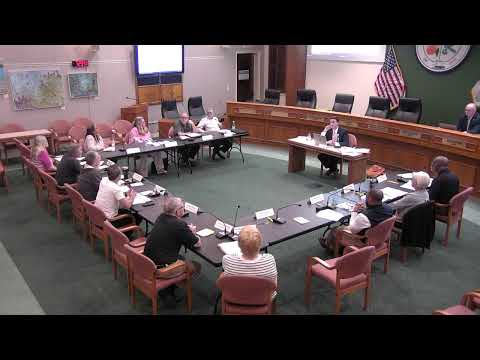
Oviedo charter committee debates qualifying rules, petition thresholds and whether to lengthen council terms
Summary
The Charter Review Committee discussed tightening charter language to clarify qualifying paperwork availability, noted that nominating-petition signatures were raised from 25 to 150 in 2021, and opened a broader debate about moving council terms from two to four years to save election costs and affect turnout.
The Oviedo Charter Review Committee on Feb. 11 reviewed multiple election-related charter provisions, flagging ambiguities in the qualifying window, confirming the nominating-petition signature requirement was raised to 150 in 2021, and beginning a discussion about whether council-member terms should shift from two years to four.
Unidentified Speaker 9 opened the discussion by reminding the committee that municipal elections must conform to the Florida election code and that the charter defers to mandatory state provisions where conflicts arise. "Whenever practicable and in the best interest of the city, the city council may enter intergovernmental agreements with the Seminole County Supervisor of Elections to implement the election state," the speaker said while walking the committee through Section 3.03.
Committee members focused first on qualifying rules. Section text sets a five-day qualifying period starting Monday at 8 a.m. and ending at noon Friday two weeks before the state primary, but staff and members emphasized candidates can pre-file paperwork. Unidentified Speaker 11 captured the committee's concern: "I'm looking for a statement that says qualifying paperwork is available prior to this qualifying period." Staff said they are preparing an outreach campaign and can better publicize that packets are available outside the formal qualifying week, and the committee asked staff to add a related action item for follow-up.
The committee also recorded that the charter was amended in 2021 to raise the required number of registered voters signing nominating petitions "from 25 to 150," a change Unidentified Speaker 9 pointed out for the record. Members discussed whether 150 remains an appropriate threshold and how the higher threshold changes candidacy barriers compared with historical practice.
A substantial portion of the meeting turned to term-length tradeoffs. Several members argued four-year terms, timed with gubernatorial or presidential elections, could reduce city election costs and increase turnout; others raised concerns about accountability, the transition mechanics (which incumbents would have terms shortened or lengthened), and campaign fatigue. Unidentified Speaker 9 said the committee would table specific drafting until it had more time to develop concrete ballot language and implementation options. "If there does end up being a will on the CRC to recommend that, then we'll come up with a way to put it together," the speaker said.
The committee also noted policy constraints: ranked-choice voting is currently prohibited by Florida law, a point Unidentified Speaker 9 made during a discussion of alternative ballot structures. Members asked staff to return with draft charter language and potential implementation scenarios (including budgetary estimates tied to election timing) at a future meeting.
The committee approved the minutes for Jan. 14 and Jan. 28, 2026, and closed the discussion by listing follow-ups: clarifying qualifying/paperwork availability, considering a cleanup amendment on special-election timing, and continuing the terms discussion at the next meeting.