
Adams County staff urge adoption of state wildfire-resiliency code while preserving flexibility amid map changes
Get AI-powered insights, summaries, and transcripts
Subscribe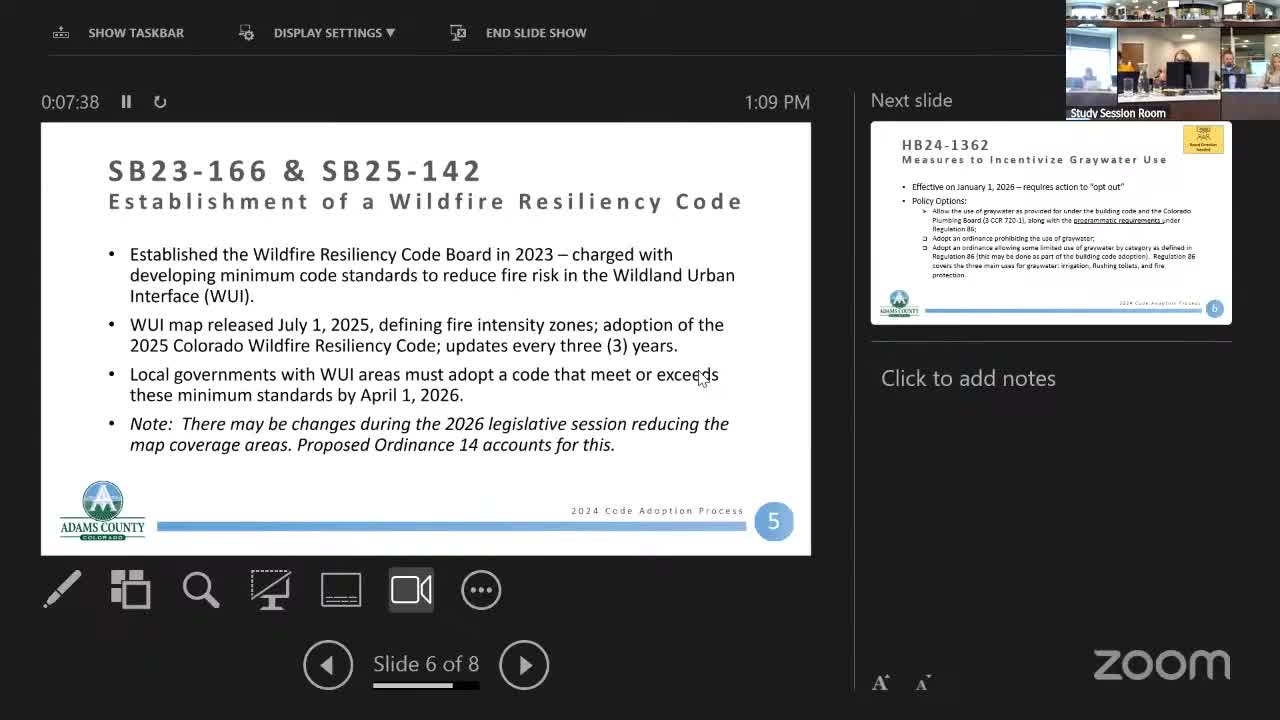
Summary
County staff recommended adopting the Colorado Wildfire Resiliency Code by ordinance to meet the state's April 1, 2026 deadline, while leaving room to adjust if the statewide WUI map is updated; the board agreed to proceed and to schedule technical follow-ups.
Adams County staff told commissioners they will move to adopt the Colorado Wildfire Resiliency Code to comply with a statewide requirement that takes effect April 1, 2026, while building local flexibility into the ordinance in case the state's WUI (wildland-urban interface) map is revised.
The recommendation came during a broader presentation on building-code updates and related legislation. Jenny Hall, community and economic development director, and Justin Blair, chief building official, said the county must adopt the state model code by ordinance to meet the deadline but can include edits that preserve local enforcement details and reference a changing map rather than hard-coding boundaries.
Why it matters: the state's process designates areas by risk zone (clear, yellow, orange, red) and ties specific construction and landscape standards to those zones. In practice, that means permit-triggered requirements such as Class 1 roofing materials, ember-resistant ventilation screens, one-hour fire‑rated assemblies in higher-risk areas, and defensible-space landscaping for affected properties. Staff stressed that existing structures are not immediately retrofitted; requirements typically apply when a structure is permitted for work such as reroofing.
Commissioners and staff highlighted county-specific concerns and implementation steps. Several commissioners asked about the map's footprint in Adams County and insurance implications; staff said the map is public and that a sizable portion of unincorporated county land is affected, though Adams County is "one of the least impacted counties" compared with mountain jurisdictions. Staff said they will coordinate closely with local fire districts and the county's office of emergency management and will provide clear public-facing guidance for applicants during permitting.
Next steps: staff will prepare an ordinance (or separate ordinances for building code and WUI, as appropriate), schedule public hearings, and hold a focused study session on residential sprinklers that commissioners requested. The county aims to meet the July 1, 2026 code-adoption timeline tied to other statutory triggers while ensuring the WUI ordinance can be updated if the state map changes.
A county official emphasized the practical point: "It's not that everyone has to be retrofitted immediately," and that the code chiefly changes requirements tied to permitting and new construction in designated zones. The board directed staff to proceed with drafting and outreach and to brief the commission again on technical implementation.