
Committee hearings on H.716 focus on net-metering compensation, negative adjuster and metering feasibility
Get AI-powered insights, summaries, and transcripts
Subscribe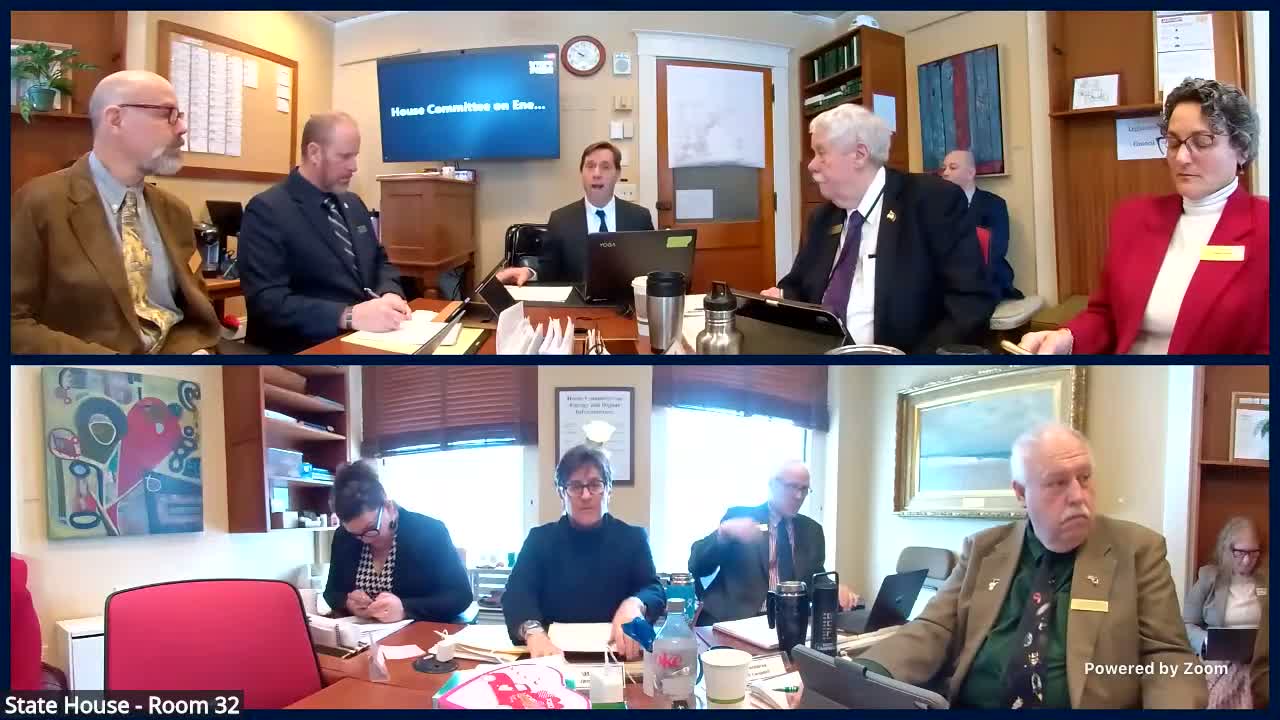
Summary
Witnesses urged H.716 to reduce the -4/kWh penalty for behind-the-meter use and to incentivize batteries; the Public Service Department warned the bill could raise rates, not change greenhouse gas emissions and may be technically infeasible for utilities lacking hourly meters.
The House Energy Committee heard extended testimony and questioning on H.716, a bill that would change the net-metering compensation formula for rooftop and behind-the-meter solar.
Peter Sterling, executive director of Renewable Energy Vermont, told the committee "I'm Peter Sterling, executive director of Renewable Energy Vermont" and said the end of the federal residential solar tax credit and delays to Solar-for-All funding make state action more urgent. Sterling described how the PUCs statewide blended rate is calculated and how "negative adjusters" (for size and REC ownership) are subtracted from that blended rate, reducing the dollar amount paid to new net-metering systems. He said the adjusters have increased over time and that "Vermonters are receiving less money for the net metering credits they generate." Sterling argued removing the negative 4/kWh adjuster for behind-the-meter consumption would encourage storage adoption and on-site resilience and that many benefits of behind-the-meter generation (for example avoided transmission and resiliency) are not fully monetized in current analyses.
TJ Korr, director of regulated utility planning at the Public Service Department, told the committee the department has three main concerns with H.716: "1, we believe it would lock in upward rate pressure. 2, it will not support any progress towards greenhouse gas reductions, period. And 3, it creates some complexity and confusion around billing, which Im actually not sure will be even feasible for all utilities." Korr emphasized that the 2017 legislature delegated rate-setting authority to the Public Utility Commission to allow an expert, fact-based, transparent process that balances deployment, cost shift, greenhouse gas targets and the cost of technology.
The committee questioned both witnesses about practical implementation. Members asked whether rooftop generation first serves on-site load (Sterling: "It's just the math... flows out and then we keep track of how much I'm exporting") and whether utilities have advanced metering infrastructure (AMI) needed to measure hourly behind-the-meter consumption. Korr warned that while some utilities (for example Green Mountain Power) have advanced meters, "not everybody yet" has AMI and that billing systems and hourly accounting could be infeasible for certain municipal utilities and cooperatives without further upgrades.
On equity and emissions, Korr said modest compensation changes would not overcome upfront cost barriers for many Vermonters and argued H.716 would have "0 impact on greenhouse gas emissions" because the Renewable Energy Standard sets deployment; utilities will meet RES requirements either through net metering or other contracts. Sterling countered that some societal benefits (price suppression in the regional market, avoided transmission, resilience) reduce overall system costs and should be counted in any benefit-cost analysis.
Committee members raised the policy trade-offs: whether the legislature should set deployment targets and let the PUC design rates, or whether explicit legislative compensation changes are warranted to spur rooftop solar and storage. The committee recessed with plans to continue testimony at a later session.
The testimony included discussion of Solar-for-All funding (paused and in litigation), estimates for residential households served under prior program designs (witnesses referenced roughly 1,000 households for small residential allocations), and that group net metering options were largely eliminated by earlier reforms, leaving power-purchase agreements or market sales as alternatives for larger community projects.
Next procedural steps were not a vote on H.716; the committee indicated it would hear additional testimony and continue the record before considering amendments.