
Rockingham County Schools warns of multimillion‑dollar shortfalls as state budget remains unsettled
Get AI-powered insights, summaries, and transcripts
Subscribe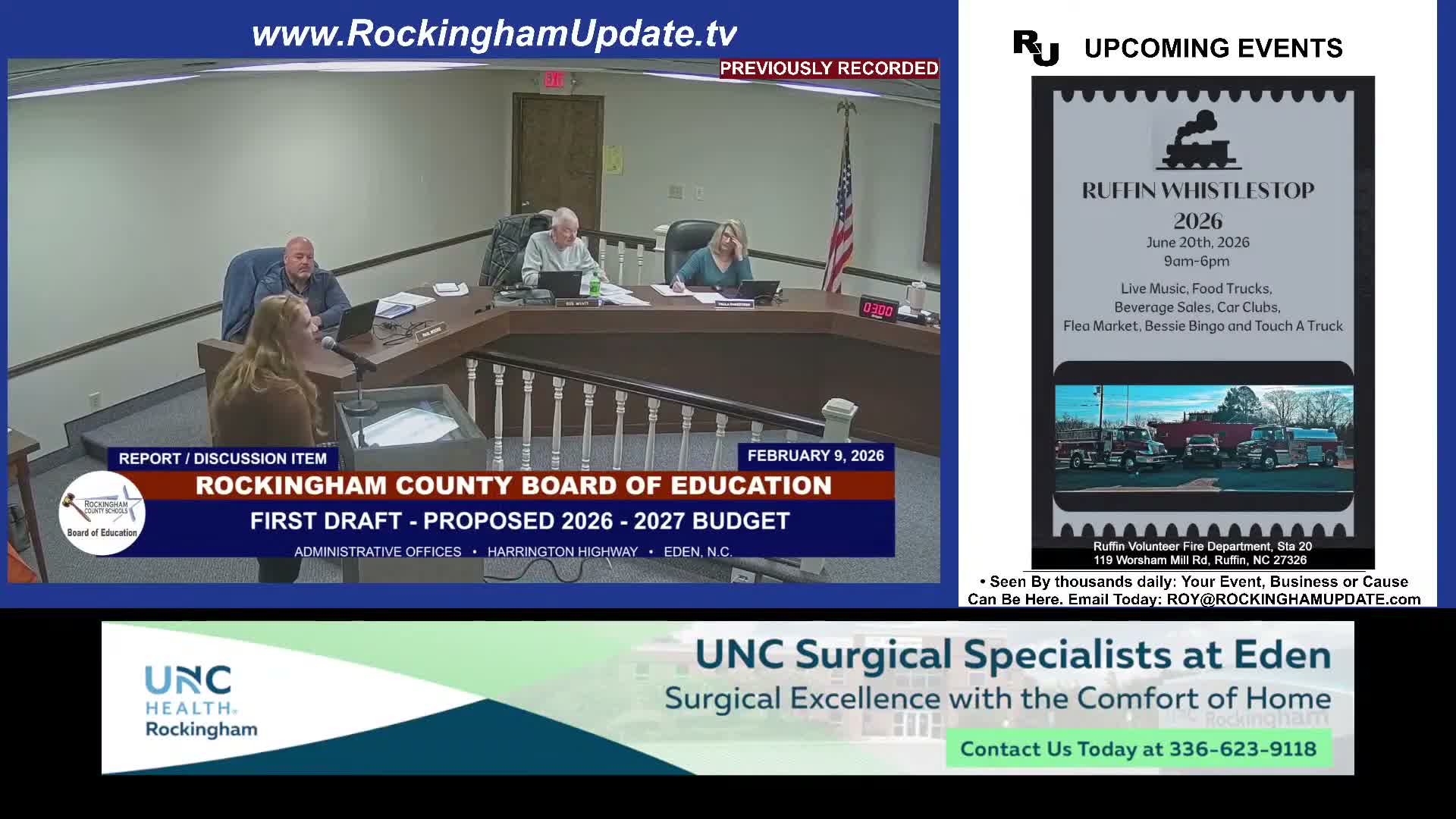
Summary
District finance staff told the school board the stalled state budget and lower projected ADM could cut state funding by about $6.8 million next year; staff flagged a worst‑case $3.6 million shortfall in exceptional‑children funding and recommended planning steps including reducing positions via attrition and exploring school consolidation.
District finance staff presented a high‑level draft of the Rockingham County Schools 2026‑27 budget to the board on Feb. 9, warning that unresolved state budget decisions and declining enrollment will require near‑term adjustments.
Annie Ellis, presenting the 30,000‑foot view of the budget, said North Carolina’s stalled biennial budget and proposed income‑tax reductions could reduce state revenue available for K‑12 education; the district’s potential exposure was described by staff as roughly $6.8 million under one scenario tied to tax‑rate changes. Ellis said the district already projects a drop in average daily membership (ADM) — the state will fund the district at 10,740 students next year versus 10,885 this year — a decline that reduces both position allotments and dollar allotments.
Ellis and other staff laid out possible impacts: an estimated loss equivalent to about 8.5 classroom teaching positions, one enhancement teacher, and two instructional support positions tied to the lower allotments, plus roughly $1.0 million in reduced non‑position dollar allotments. Exceptional‑children services (EC) face a separate budget pressure; staff described a possible $3.6 million shortfall for EC across funds and said local funds may need to cover at least $1.0 million of that gap. The district’s locally held fund balance was cited at about $4.8 million beginning the year, with $1.0 million already appropriated and a projected year‑end balance of approximately $3.8 million.
Board members and staff discussed tools for addressing shortfalls: prioritizing classroom staffing, using attrition to reduce positions, avoiding across‑the‑board cuts to instruction, and reviewing building consolidation to reduce fixed costs tied to operating many aging facilities. Staff scheduled finance committee meetings (Feb. 11) and a work session (Feb. 23) to review line‑item detail and a proposed calendar for the budget process; final proposed budget is expected for board approval on March 9 and transmittal to county commissioners thereafter.
What’s next: staff will refine planning allotments once the state publishes them (expected in late Feb. per staff) and return to the board with detailed line‑item recommendations and a timeline for potential staffing and facility adjustments.