
Council tables proposed clear‑cutting policy changes after members raise legal concerns
Get AI-powered insights, summaries, and transcripts
Subscribe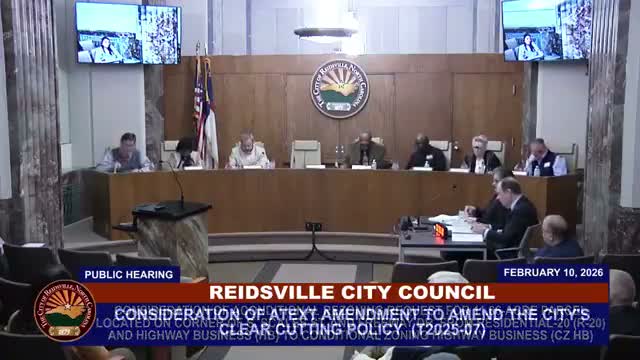
Summary
Council moved to table proposed amendments to the city's clear‑cutting policy for 60 days after debate over buffer widths, bond provisions, exemptions, and a cited North Carolina Court of Appeals ruling that council members said could expose the city to takings litigation.
Reidsville staff presented a comprehensive set of amendments to the city's clear‑cutting policy on Feb. 10, proposing a three‑part structure that would set general permitting rules, require a 25‑foot residential buffer with a bond if the property is cleared under a development exemption, and apply a 25‑foot buffer (with a five‑year exemption) for commercial properties that abut residences.
The proposed amendment would allow property owners who obtain development approval to clear buffers (residential: exemption if developed within three years; commercial: five years). Staff proposed leaving the dollar amount of a required bond up to a forester or the applicant and said the bond would be used to replant the buffer should development not proceed. Staff recommended the council pursue the text changes; the planning board recommended approval but not unanimously.
During debate, council members raised concerns about the violation remedy in the ordinance, which would deny plan approvals for three years to properties for which protected buffers were unlawfully removed. A council member cited a Feb. 6 North Carolina Court of Appeals decision he said found similar prohibitions could be a compensable taking, creating litigation risk and potentially large legal fees. Council members asked for formal legal review.
Multiple council members urged caution and asked staff and the city attorney to research relevant case law before adopting a violation provision that could be construed as denying landowner development rights. One member suggested approving the policy without the three‑year denial provision or relying on existing $100/day zoning violation remedies while staff obtains counsel. After extended debate, a motion to table the amendment for 60 days passed (transcript records the motion, second and vote call; a roll‑call tally is not transcribed).