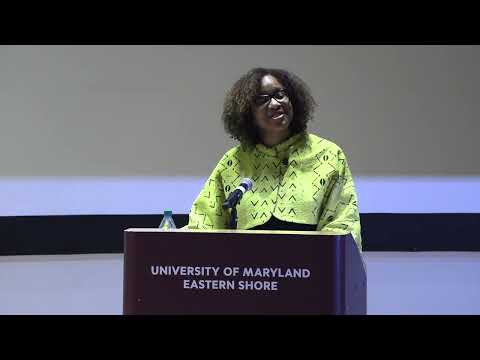
Harvard Divinity School Dean Marla Frederick urges UMES students to remember HBCU history and stay engaged
Loading...
Summary
Dean Marla Frederick delivered the keynote at the University of Maryland Eastern ShoreBlack History Month kickoff, urging students to preserve HBCU memory, honoring the often-overlooked role of Black women in building colleges, and answering student questions about leadership, graduate school and civic engagement.
Dean Marla Frederick, dean of the Harvard Divinity School, told students at the University of Maryland Eastern ShoreBlack History Month kickoff that remembering the history of historically Black colleges and universities is vital to preserving dignity and opportunity.
Frederick opened her remarks by connecting personally to the audience, citing her Spelman College roots and describing HBCUs as "beacons of light" that have produced disproportionate shares of Black professionals despite chronic underfunding. "This is the work we must hasten to complete as generations pass before our very eyes," she said.
The speech, titled "HBCUs and the Making of American History," emphasized the power of memory and the duty of scholars and institutions to restore voices missing from historical records. Frederick cited Zora Neale Hurston's work and read lines from Langston Hughes to frame the talk around stories of trauma, resilience and hope. She urged students to "remember and to know the history" as a means to sustain democratic gains.
Frederick also highlighted the central but often untold role of Black women in founding and sustaining HBCUs, citing founders such as Sophia Packard and Harriet Giles and describing how womenthrough organized fundraising and community laborkept institutions alive. She described family history from Morris College to illustrate how collective, often gendered labor financed campus buildings and programs.
Quoting figures she attributed to U.S. Secretary of Education Miguel Cardona, Frederick said that while HBCUs comprise roughly 3% of U.S. colleges and universities, they graduate nearly 20% of Black students who earn bachelor's degrees and produce a substantial share of Black judges, doctors and Ph.D. recipients. She warned that recent budget cuts, the removal of historical materials and efforts to limit curricula put those gains at risk.
In a moderated question-and-answer session, Armani Dukes, UMES student government president, asked about leadership, graduate-school transitions and civic engagement. Frederick encouraged involvement in student government and campus organizations as practical leadership training and urged students to seek mentors, persist through setbacks and "maximize your time in college." On social media, she recommended limits and deeper reading as a counterbalance to performative pressure: "Thereis so much more to life. There's so much more to learn than the kind of doom-scrolling these social media giants are programming us to do."
Frederick closed by calling students to action: "Enter to learn, depart to serve," and urged them to use their education to protect civil rights and public goods. The host announced a post-event reception where attendees could continue the conversation; UMES presented Frederick with a small gift and formally closed the program.
The reception followed the program; Frederick remained available for individual questions and photos.