
Provo planning panel backs Novell-campus data center; rezoning recommendation to council passes 5–2
Get AI-powered insights, summaries, and transcripts
Subscribe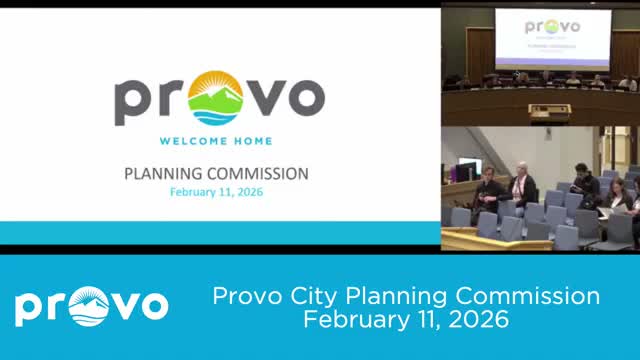
Summary
The Provo City Planning Commission recommended rezoning property at 1507 S. 180 E. for a proposed data center and approved the project's plan with conditions, including a development agreement barring on-site power generation, limits on culinary water use, and third‑party removal of cooling waste.
The Provo City Planning Commission on Feb. 11 recommended that the City Council approve a zone-map amendment to allow a data center overlay at 1507 South 180 East and unanimously approved the project's plan, subject to conditions including updated CRC-approved plans, a combined final plat moving the parcel so a nearby charter school is not within 200 feet, and a Transportation Demand Management agreement to allow 72 parking stalls.
The commission voted 5–2 to forward the rezoning recommendation and approved the project plan 7–0. The applicant—who identified himself to the commission as Steven Steiler—said the proposal is a small-scale facility that would start at about 5 megawatts of grid power and could scale up if Provo Power and UMPA secure more supply. "This is very, very, very small," Steiler told the commission, distinguishing the proposal from hyperscale centers.
Why it mattered: Commissioners and members of the public pressed for protections on several fronts—power procurement, water use, noise and emergency generator testing, and long-term land use for East Bay. The mayor's office had submitted a letter urging caution, arguing that "additional data centers are not in the best interest of Provo's residents" and that the commission should consider City economic-development priorities before approving a zone change.
Power and rates: Tad Smallcomb, speaking for Provo Power, said the data center will enter a negotiated power purchase agreement through UMPA and that transmission and interconnection upgrades are expected to be paid by the project. "You shouldn't see any impact on the Provo residents," Smallcomb said when asked whether the project would raise city power rates. He also said the city could realize revenue from selling bulk, baseline power to a constant customer but that studies of system impacts and any line or substation work are still ongoing.
Water, cooling and environmental safeguards: The applicant proposed closed-loop cooling and said it is exploring use of treated wastewater (referred to in the record as "silver water") from the adjacent treatment plant to reduce fresh-water demand. Public Works staff warned about past incidents elsewhere of highly cycled discharge creating sewer sludge, and recommended that water-discharge handling and any reuse arrangement be written into a development agreement. Public Works told the commission the applicant estimated a maximum of about "12,000 gallons" of treated wastewater in the usage figure provided, but the transcript does not specify the period tied to that number.
Conditions and binding promises: Commissioners made the development agreement central to their recommendation. For the rezoning recommendation the commission required that the development agreement explicitly prohibit on-site power generation, require the closed-loop or similarly limited culinary-water usage within the applicant’s stated thresholds, and require third-party removal of any glycol or cooling waste so it is not discharged into the municipal sewer. At the project-plan vote, commissioners required (1) updated plans and equipment mitigation approved by the City's CRC, (2) a final plat combining the two parcels and adjusting parcel lines so the nearby charter school is not within 200 feet of the data-center parcel, and (3) a recorded TDM to allow a 72-space parking reduction.
Public comment and land-use tradeoffs: Dozens of residents spoke during public comment with divided views. Neighbors and East Bay district leaders raised concerns about proximity to a school, potential noise from backup generators, water and air impacts, the small number of permanent jobs a data center typically creates, and whether this ‘‘prime’’ redevelopment site should be reserved for uses that boost local employment. Others and several commissioners argued data-center capacity supports local tech businesses, nearby universities and health-care uses that rely on high-performance computing.
What happens next: The zone-map amendment is a recommendation to the municipal council; the development agreement and the proposed conditions will be part of that council review. The commission recorded specific conditions in its recommendation; the council will consider them when it takes up the rezoning request.
Reporting notes: This article uses direct quotes and attributions to speakers as recorded in the Feb. 11 meeting transcript. Vote outcomes reported here reflect the commission's recorded votes (rezoning recommendation 5–2 in favor; project-plan approval 7–0).