Get Full Government Meeting Transcripts, Videos, & Alerts Forever!
Get email alerts on the Governance And Recruitment topic
No spam. Unsubscribe anytime.
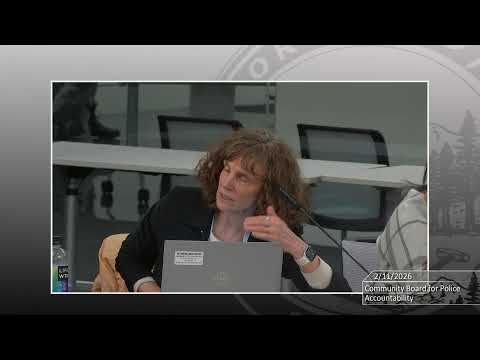
Portland’s new police oversight board begins work, green-lights director search and facilitator outreach
Summary
At its first meeting, Portland’s Community Board for Police Accountability introduced members, asked staff to begin recruiting an OCPA director using a city-contracted executive search firm, and directed outreach to facilitators to help draft bylaws and meeting procedures. The board also scheduled an extra meeting and heard broad public calls for independent counsel and community involvement.
Portland — The Community Board for Police Accountability (CBPA) held its inaugural meeting to introduce 21 volunteer members, discuss governance options and authorize staff to begin recruiting a director for the Office of Community-Based Police Accountability (OCPA).
Kristen Thorpe, the limited-term OCPA employee supporting the board, told members the city’s FY2025–26 budget includes funding for a director position classified as Director 1, with a salary-and-benefits figure she cited as $233,729 a year. Thorpe recommended engaging Modus, a local BIPOC-owned executive search firm already under city contract, to run the recruitment. She said the firm’s fee would be 30% of the agreed salary, payable in three installments.
“Once the oversight system is operational, that position could always be reclassed if it’s deemed appropriate at that time,” Thorpe said during the presentation. She told the board she would contact the firm and arrange a presentation for members.
Why it matters: The board cannot begin hearing cases until the OCPA is staffed; hiring the director is the necessary next step in staffing and opening the oversight system. Members repeatedly urged a transparent, community-informed search process, including public input on qualifications and a community survey.
The board also discussed how it will govern itself. Members debated leadership models — a single chair, co-chairs or co-facilitators — and whether to adopt Robert’s Rules of Order or collaborative decision models. Several members asked staff to present options rather than electing officers immediately; the group agreed to postpone final decisions on leadership until members review governance models and training materials.
Thorpe recommended hiring an outside facilitator to develop bylaws and standing operating procedures. She identified two contractors already used by the city and suggested inviting them to present their approaches to the board before any selection.
Budget and operations: Thorpe provided a high-level preview of proposed OCPA budget placeholders prepared with the city operations office, noting the board’s annual budget will be proportional to 5% of the Portland Police Bureau’s adopted operating budget. Estimates presented to the board included roughly $3 million for facilities and nearly $5 million for employees, materials and services — a combined placeholder near $8 million; officials said final numbers depend on the PBB total and council action.
Public comment: The board heard lengthy public testimony urging urgency, broad community engagement, independent legal counsel and care in choosing vendors. Former Commissioner Joanne Hardesty and community advocates called on the board to use its full authority and to lean on experienced oversight bodies and experts for briefing and technical assistance.
Next steps: Thorpe said she will contact Modus and the proposed facilitators to schedule presentations and gather written materials for the board. Members also added an extra meeting two weeks later to advance these items and agreed to revisit meeting cadence at the March session.
Votes at a glance: The board gave staff direction by raise-of-hands to engage the city-contracted search firm for recruitment outreach and to invite facilitators to present; members also approved scheduling an extra meeting on February 25. The decisions were recorded as show-of-hands approvals rather than roll-call tallies.