
House subcommittee advances dozens of bills; landlords, paid leave, energy programs among measures reported
Get AI-powered insights, summaries, and transcripts
Subscribe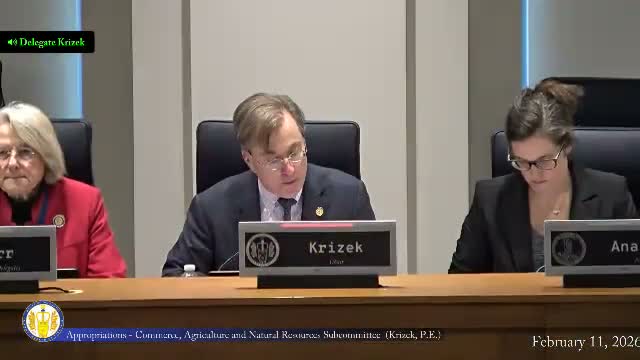
Summary
The House Commerce, Agriculture and Natural Resources subcommittee heard presentations on more than 25 bills, reporting the majority to the House (several unanimously) and tabling a handful for further consideration. Key items included paid family leave, codifying a SWaM procurement program and a requirement for accounting of hunting-license exemptions.
The House Committee on Commerce, Agriculture and Natural Resources met to consider a packed docket of bills affecting energy policy, housing, labor and natural resources and voted to report most of them to the full House while tabling several with fiscal concerns.
Delegate Dougie Fowler introduced House Bill 45, which would require the Department of Wildlife Resources to annually account for revenue forgone because of license exemptions enacted on or after July 1, 2026, and direct the Department of Accounts to transfer the equivalent amount into a designated fund within 30 days. Fowler said the bill "stops that" practice of handing out free licenses and "prevents that." Committee members pressed for the fiscal magnitude of the proposal; a motion to lay HB 45 on the table succeeded 5–2.
Codifying procurement targets for small, women- and minority-owned businesses was a front-and-center item. "Executive orders can be rescinded by a governor at any time," Delegate Ward said in support of House Bill 61, which would move SWaM procurement targets into statute. The committee reported HB 61, 5–2.
The subcommittee also reported a range of labor and workforce measures. Delegate Sewell presented the substitute for House Bill 1207 to establish a paid family and medical leave program administered by the Virginia Employment Commission; the bill as amended would provide up to 12 weeks of leave and "payments starting at 2 weeks after the claim is filed at 80% of an individual's average weekly wage," with a maximum benefit equal to 100% of the state's average weekly wage. Sewell said the measure anticipates a startup loan (presenter cited roughly $75 million) to be repaid from contribution revenues. The substitute was reported 5–2.
Energy and climate-related bills advanced as well. Delegate Helmer’s House Bill 285 would create a distributed energy resources task force and was reported 7–0; Delegate Lopez’s amended bill to establish the Virginia Clean Energy and Innovation Bank — intended to finance clean-energy projects through grants, loans and credit enhancements — was reported 5–2 after a small amendment to fund the board’s operations.
Several bills were tabled on fiscal grounds. The committee voted to table HB 599 (oyster stock assessment schedule) and HB 1098 (brownfield renewable energy grant capital request) by 5–2 votes, and tabled HB 1038 (Student Environmental Literacy Grant Fund) and HB 698 (foundation for the Department of Workforce Development and Advancement) by voice votes of 7–0.
Votes at a glance: the committee reported HB 285 (7–0); HB 1249, HB 796, HB 903 and several others (mostly unanimous or near-unanimous); reported HB 61, HB 260 (as substituted), HB 527 (VERP), HB 1207 (as substituted) with narrower margins; and tabled HB 45, HB 599, HB 1098, HB 1248 and others. The hearing concluded with routine housekeeping — HB 1042 was passed by for the day — and adjournment.
What’s next: measures reported by the subcommittee move to the House docket for additional consideration. Bills that were tabled may be taken up again if sponsors or committee members bring them back for a future vote.