
House education committee moves to embed at‑risk funding into formula; broad advocacy in support
Get AI-powered insights, summaries, and transcripts
Sign Up Free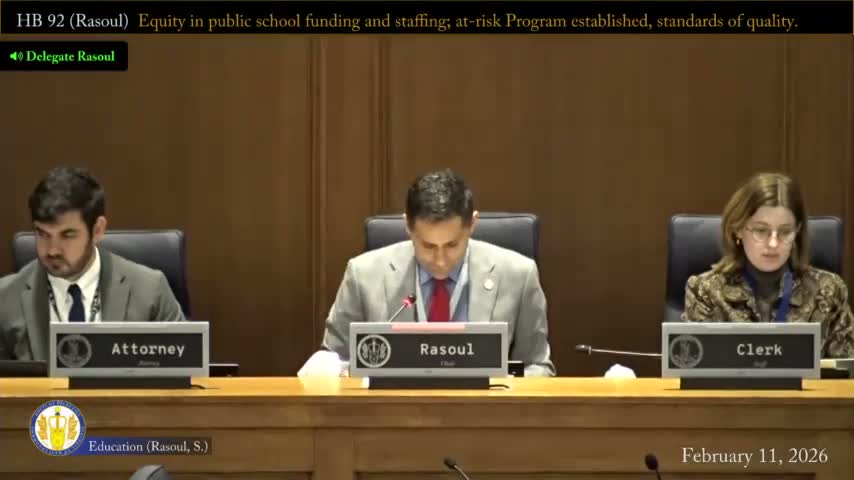
Summary
The committee reported a substitute for HB 92 to codify at‑risk and special‑needs add‑on funding into Virginia’s school funding formula after several groups including the Commonwealth Institute, Virginia Education Association and local school officials testified in favor; committee vote 18-1.
The House Committee on Education reported a substitute for House Bill 92 that would integrate funding for students from low‑income families and students with disabilities into Virginia’s primary school funding formula.
Sponsor Delegate Rasul said the substitute codifies practices funded in the last biennium and adds reporting requirements for the Department of Education. Supporters testifying in person and online described the measure as a necessary step toward funding equity. Levi Gorn of the Commonwealth Institute said the substitute "is good legislation that codifies the funding for students from low income families as well as students with disabilities into the main funding formula." Chad Stewart of the Virginia Education Association and local school board representative Katie Ricard also urged the committee to pass the bill, citing classroom examples and the need for wraparound supports.
Other witnesses included Voices for Virginia's Children and New Virginia Majority, and Jeremy Bennett of the Virginia Association of Counties said VACO supports additional state investment to implement JLARC recommendations. After testimony the committee reported the substitute by roll call 18-1.
The substitute was described as preserving prior funding but embedding it into the main funding formula so school divisions receive the add‑on funding as a consistent component of per‑pupil allocations. The committee recorded the roll 18 to 1 and the measure will move forward for further consideration.