Subcommittee tables bill to grant in‑state tuition to members of federally recognized tribes
Loading...
Summary
A House appropriations subcommittee tabled HB 287, a bill to allow citizens of federally recognized tribes enrolled as undergraduates to pay in‑state tuition; proponents called it restorative, analysts gave a range of fiscal estimates, and supporters urged the committee to weigh enrollment uncertainty.
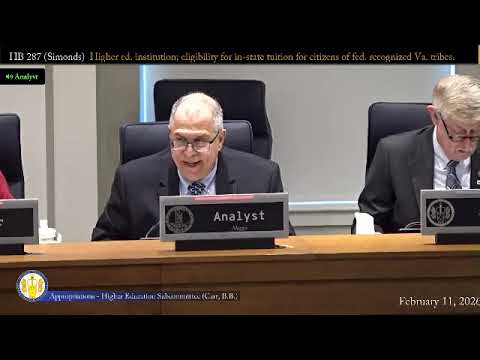
A House Appropriations Subcommittee of Higher Education on Feb. 12 tabled House Bill 287, which would let non‑Virginia students who are citizens of federally recognized tribes and enrolled in undergraduate degree programs be treated as in‑state students for tuition and enrollment purposes.
The committee, led by the chair of the subcommittee, adopted line amendments to the bill before hearing analysis and testimony. Tony Maggio, the committee analyst, told members the average difference between in‑state and out‑of‑state undergraduate tuition is about $20,000 per student and about $15,000 for graduate tuition. Maggio said a survey cited up to 80 potentially eligible individuals (represented in one reading as 80 total over four years), and that at 80 students the institutions could face roughly $1.6 million in annual revenue loss. He added that treating those students as in‑state could create a general‑fund subsidy impact of about $10,000 per student, putting an estimated annual general‑fund exposure near $1 million and a four‑year general‑fund impact on the order of $4 million; combining institutional revenue and subsidy effects, he said total impact could approach $10 million over four years.
Supporters told the committee the likely number of students who would use the change is considerably lower. Deborah Rodman, testifying for the Nansemond Indian Nation and the Rappahannock Indian Tribe, said tribal citizens have a "very low rate of actually going to college" and that the survey's headline number likely overstates annual enrollment; she said the real annual number is likely closer to 20. Morgan Faulkner, general counsel for the Upper Mattaponi Tribe, described her family's history of restricted access to education and called the bill "restorative," saying it "would help bring our kids home, to get their education." Thomas Badamo (Nansemond Indian Nation) corrected an earlier interpretation of the estimate, saying, "I believe it's 20 per year and was identified as 80 total over the next 4 years," and framed the bill as a step to mitigate harms caused by Virginia's Racial Integrity Act of 1924.
Jackson Martingale, a member of the code commission, told the committee the fiscal impact will vary by institution and that some institutions indicated no fiscal effect, noting that not every eligible student would necessarily take advantage of in‑state tuition if they already have in‑state options in their home states.
After questions and discussion about fiscal exposure and enrollment uncertainty, Delegate Reid moved to "gently lay this on the table" and continue evaluation as the budget process progresses; the motion was seconded and the committee agreed to table the bill pending further budget review.
The bill's proponents said the change is largely symbolic for a small number of students but carries restorative significance for tribes whose members were historically excluded from Virginia schools. The committee did not vote to advance the bill out of committee; members said they will reexamine the proposal as budget information becomes available.