Get AI Briefings, Transcripts & Alerts on Local & National Government Meetings — Forever.
Virginia Senate Committee Advances Minimum‑wage Bill, Moves Dozens of Measures Forward
Loading...
Summary
A Senate of Virginia committee in Richmond reported several bills including a minimum‑wage increase (SB 1), a grant program to recruit medical professionals to underserved areas (SB 625), and measures on prevailing wages and health coverage; several larger proposals were carried over for budget or interim review.
RICHMOND — The Senate of Virginia met in Committee Room A‑305 and voted to report a slate of bills and carry several larger, budget‑sensitive measures for further study.
Among the measures the committee reported was SB 1, a bill to raise Virginia’s minimum wage from $12.77 to $13.75 on Jan. 1, 2027, then to $15 on Jan. 1, 2028, with indexing to the Consumer Price Index beginning in 2028. The committee also agreed to report SB 625, which converts an existing loan‑repayment approach into a grant program intended to recruit clinicians to medically underserved areas.
The session included discussion of several other notable items. Senator Obenshein, sponsor of SB 539, described a proposed Virginia Public Safety Communications Infrastructure Fund intended to assist localities with grant support for storm and flood risk and to improve emergency communications interoperability after gaps identified following a hurricane in Southwest Virginia. “This is to create the vehicle, not necessarily to appropriate funds,” Obenshein said, noting potential private contributions and federal grants. The committee voted to carry SB 539 over so the proposal can be considered in the budget process.
Labor‑related bills drew extended attention. The committee considered measures to consolidate wage‑theft claims (SB 644), to restrict noncompetes for health‑care professionals with carve‑outs for business sales (SB 128), and to keep prevailing‑wage enforcement and interpretation within Virginia law for certain projects (SB 758). Senator Rouse explained that SB 758 aligns state prevailing‑wage rates with the Virginia Commission of Labor and Industry and removes a reference to federal Davis‑Bacon determinations.
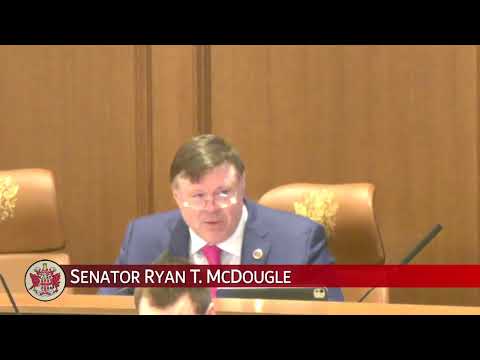
On health and insurance, the committee heard SB 257, which would require insurers to cover one prescription and one nonprescription opioid antagonist at the lowest cost tier for people in substance‑use disorder treatment and to require pharmacies to post public notices that the drug is available; the bill was reported. Senators also discussed a bill to expand insurance coverage for FDA‑approved contraceptives and related devices; Senator McDougall asked whether over‑the‑counter products such as condoms would be included, and staff replied that products now available without a prescription were intended to be covered.
Several measures were carried over for budget or interim review, including SB 539 (public‑safety fund), SB 668 (state PBM procurement language, with a line amendment to extend DMAS RFP timing), SB 80 (funding for volunteer fire and rescue programs), and SB 99 (changes to medical malpractice recoveries and caps, which the sponsor said would affect malpractice premiums and major health systems). For carried bills, the committee generally agreed to revisit funding and fiscal impacts during the budget process or interim work.
Votes at a glance: SB 1 (minimum wage) — reported out of committee; SB 128 (health‑care noncompetes) — reported; SB 257 (opioid antagonist coverage) — reported; SB 326 (cooperative procurement for roofing) — reported; SB 518 (prevailing‑wage substitute) — patron substitute agreed and bill reported; SB 625 (loan repayment → grant) — reported; SB 644 (wage‑law consolidation) — reported; SB 539 (public‑safety communications fund) — carried over for budget consideration; SB 668 (PBM bill) — carried over; SB 80 (volunteer fire programs funding) — carried over; SB 99 (medical malpractice cap changes) — carried over.
Committee members flagged fiscal questions and implementation details for several items. Sponsor estimates and staff comments about cost‑sharing, RFP timing, and fiscal effects were raised repeatedly, and the chair directed that bills with budget implications be revisited in the budget process or carried to full committee when necessary. The committee adjourned after clearing the docket and announced the broadcast concluded.
Next steps: Reported bills move forward in the legislative process toward consideration by the full Senate or other relevant stages; carried bills will be revisited in budget deliberations or interim committee work.