
Tennessee short-line operators ask lawmakers to restore $20 million annual grant pool
Get AI-powered insights, summaries, and transcripts
Subscribe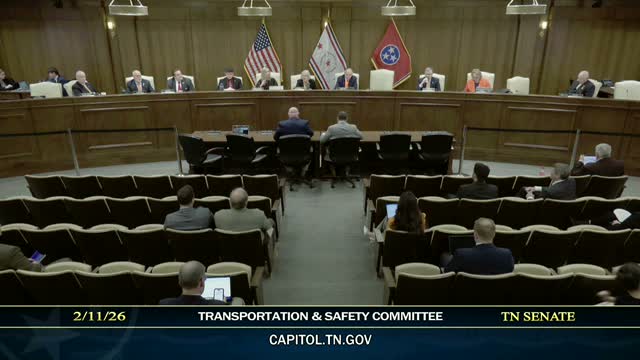
Summary
Representatives of RJ Corman and the Tennessee Short Line Railroad Alliance urged the Senate Transportation Committee to restore a $20 million recurring short-line grant pool to sustain maintenance, leverage federal CRISI grants and preserve rural jobs.
Tyler White of RJ Corman and Denny Wayne Robinson, chair of the Tri-County Railroad Authority and the Tennessee Short Line Railroad Alliance, told the Senate Transportation and Safety Committee that short-line railroads are essential first- and last-mile infrastructure for rural manufacturers and farmers and asked the legislature to restore $20 million in recurring annual grant funding.
The presenters said state support created a predictable funding pool in 2021—an $85 million allocation that they said produced roughly $20 million per year to REL authorities through 2026—and that the last allocation was distributed in July 2025. Robinson said the current program’s end threatens maintenance work, federal grant leverage and jobs in counties that depend on short-line service. "We need long term, stable, reoccurring funding so that the authorities and the operators can responsibly plan multiple year projects," Robinson said.
Tyler White described how state grants have been used to attract federal CRISI (Consolidated Rail Infrastructure and Safety Improvement) funds, sometimes achieving leverage ratios ‘‘upwards of 5 to 1.’’ He told the committee the short-line pool is not new spending but a continuation of an established program and asked lawmakers to consider restoring $20 million annually to the REL grant pool to enable multi-year planning and private investment leverage.
In question-and-answer exchanges, lawmakers pressed presenters on the typical funding shares for upkeep projects. Committee members were told upkeep funding commonly breaks down to roughly 5–10% local money, about 20% owner/operator contribution and the remainder from grants, with federal grants often covering 65–70% of project costs when available. Presenters explained the REL-authority allocations are based on TDOT needs assessments and then prorated across short lines rather than allocated purely by mileage or economic-development metrics.
Supporters on the committee framed the ask as an investment with local returns: several senators said restored funding would help preserve manufacturing investments and avoid higher costs of converting shipments to trucks. Chairlady Massey said the committee would work with TDOT to clarify remaining program balances and accounting before making a funding decision.
The committee did not take a formal vote on the funding request during the hearing; presenters left the committee with an ask and supporting documentation for lawmakers to consider.